Showing posts with label Raga. Show all posts

Sunday, June 12, 2011

Ustad Nisar Hussain Khan - Raga Chhayanat, Desi Todi, Bhairabi


Ustad Nisar Hussain Khan 
• Raga Chhayanat, Desi Todi, Bhairabi
HMV EMI India - EASD 1427 - P.1984


Side A


A1 Raga Chhayanat - Sagari Ram-Kirpa, Jhanana Jhanana Jhananana Baaje Bichhua 25'48 


Raga Chhayanat - Sagari Ram-Kirpa - Khayal - Vilambat - Ektaal
Raga Chhayanat - Jhanana Jhanana Jhananana Baaje Bichhua - Khayal - Drut - Teentaal 


Side B

B1 Raga Desi Todi - Sanchi Kahat Hal Adha-Rang Ye - Khayal - Teentaal 14'50
B2 Raga Bhairabi - Tarana - Teentaal 10'24


Accompaniment: 
Harmonium - Ghulam Baqar Khan
Tabla - Anando Gopal Bandopadhyay
Tanpura: Ghtjlam Akbar Khan Zulfakar Husain Khan


Ustad Nisar Hussain Khan has throughout been acclaimed as one of the greatest exponents of North Indian Classical Vocal music and today he is indeed the foremost amongst the performing Ustads in the country. He hails from Rampur district which at one time was known to be the blessed abode of classical music and musicians' in North India.

With initial training received from his grandfather Ustad Hyder Khan, Ustad Nisar Hussain Khan was subsequently groomed and nurtured by his illustrious father Ustad Fida Hussain. In the early thirties Ustad Nisar Hussain Khan emerged as an outstanding Khayal and Tarana singer when a galaxy of stalwarts like Ustad Alladiya Khan, Ustad Wahid Khan, Ustad Rajah Ali Khan, Pandit Omkarnath Thakur, Ustad Fayaz Khan, Ustad Abdul Karim Khan, Smt. Kesarbai Kerkar and others had been adorning the scene of Indian Classical music.

The rulers of Indian States had till then been continuing with their patronage for nourishment and propagation of classical music. Sir Siyajirao. Gaekwad of Baroda, was greatly impressed by the remarkable artistry of Ustad Nisar Hussain Khan and the Ustad flourished as Court Musician of Baroda for long thirty years.

Ustad Nisar Hussain Khan has developed a distinctive style of his own which savours of a synthesis between two prominent schools of Khayal singing - Sahaswan and Rampur. His unique voice is sonorous and assertive. With innovative phrases and colourful patterns. Khan Saheb renders Khayal like a great architect. He expounds Ragas in a very systematic way and his Taans gliding reposefully through octave after octave are not only accurate but crystalclear as well. His Bol-taans in Tarana are his speciality and the excellence of his virile but polished style of presentation has earned him a very prestigious position in the realm of Hindusthani Classical music.

Listening to Ustad Nisar Hussain Khan is always an experience and a present-day connoisseur might wonder how the performing art of the Old Master could develop so much dynamically keeping pace with the stride of time. The septuagenarian tistad has kept himself alive to the modern trends and his expositions always reflect his progressive outlook and a freshness of creativity.

Ustad Nisar Hussain Khan has been the recipient of many honours and Tamra Patra awards. In 1970 he was awarded Pad ma Bhushan'. He received Fellowship of Sangeet Natak Academy in 1971. Uttarpradesh Natak Academy felicited him with Award and Fellowship in 1972. He was titled as Sangeet Mahamahopadhaya by the Hyderabad Gandharva Mahavidyalaya in 1968. Khan Saheb headed India's Goodwill Mission to Nepal and Afganisthan in 1975. He visited London in 1976 on invitation to perform in an International Conference.

In this album Ustad Nisar Hussain Khan has presented Raga Chhayanat on the first side. The Vilambat Khayal is in Ektaal and the Dna is in Teentaal. The Raga unfolded in a traditional manner, has been elaborated in all its facets with highly imaginative phrases and utter precision. The Taans are lively and amazing.

On the second side Khan Saheb has first rendered a Khayal in Desi Todi set to Teentaal. The sentiment of the Morning melody has been brought out with emotional fervour and keen sense of aesthetics. The Ustad has concluded his recital with a Tarana in Bhairavi and the composition is in Teentaal. The intricate rhythmic patterns and Bol-taons executed in his typical style are not only attractive but give clear glimpses of Khan Saheb's incomparable virtuosity.

Sarengee accompaniment provided by the veteran Ghulam Baqar Khan and Tabla by the young talent Anando Gopal Bandopadhyay are additional attractions of this album.


Music ▼ +

Saturday, June 4, 2011

Budhaditya Mukherjee • Ahir Bhairav, Puria 1979


Budhaditya Mukherjee • Sitar 
 - Ahir Bhairav, Puria  
HMV EMI-India ECSD 2601 - P.1979


Side A

A1 Raga Ahir Bhairav - Alap, Jod

Side B

B1 Raga Puria - Gat - Trital


Anand Gopal Bandopadhyay, tabla


Here is another little treat from the extensive collection of His Excellency. I am looking forward to our next meeting, and maybe if he is the right mood he will pick up the surbahar or maybe even the been and strike a few notes to safely envelope us from the hardships of the dusty world. Anyhow here is one of the earliest recording I know of with Budhaditya Mukherjee. Of his total of eight LP's cut, this is his third one and the first on EMI-India, I can post three more records by him later if there is an interest. Hope you enjoy!

You can check his discography here


Budhaditya Mukherjee (1955–) is a Hindustani classical sitar and surbahar player of the Imdadkhani Gharana (school).
read more in the Wikipedia entry about him here


It was in the year 1976. A memorable event indeed. Hailing from the industrial town of Bhilai in Madhya Pradesh, a teenager was found toying with his Sitar with all the efficacies of a Maestro-in-making before a conglomeration of connoisseurs, critics and music-lovers in a major concert at Calcutta. And that was Budhaditya Mukherjee, a student of Engineering — shy, unassuming, looking more like an ascetic than a performing artiste with the glamour of the present day. His second appearance in Calcutta was more astounding, fantastic and sparkling with incredible artistry. He surprised everyone as much with his precocious talent as with his technical fitness and skill. He was immediately greeted as a Sitar-prodigy and acclaimed in no uncertain words that he was a discovery of the age in the domain of Indian Classical Music. Unanimously he was reckoned to be the torch-bearer of the rich cultural heritage of our National Art.

Budhaditya started playing Sitar at the tender age of five under the guidance of his illustrious father Mr. Bimalendu Mukherjee who is an eminent string musician having had his grooming in the style of late Ustad Enayat Khan. He imbibed ‘Gayaki’ style of Kirana School probably from his subsequent association with Pandit Jai Chand Bhatt. But it is Ustad Vilayet Khan, the sitar wizard, who has perhaps influenced him more in the later stages of this young artiste in shaping himself.

Budhaditya has been playing before a cross section of music-lovers stretching from Assam in the East to Gujrat in the West and from Punjab in the North to Karnataka in the South. He has been abroad also. Only a couple of months back he returned from a successful tour in Yugoslavia, Poland, Bulgaria and USSR as a delegate of the Government of India. Everywhere Budhaditya's virtuosity have made his full-house audience responsive. He is now twenty four and forsaking a brilliant career after obtaining first-class- first in Metallurgical Engineering, Budhaditya has opted for music which is his first love.

Budhaditya Mukherjee is now an exclusive artiste of The Gramophone Company of India Limited and for his first album from HMV, he has chosen to play ‘Alaap’ and ‘Jod’ in Raga Ahir-Bhairav on the first side. On the second side he has delineated Raga Puriya with a judicious treatment of ‘Vistar‘, ‘Taans’ and ‘Jhala’. The composition is set to Trital.

Tabla accompaniment of young Ananda Gopal Banerjee is an additional attraction for this album.
unceremoniously snipped from the sleeve notes


Music ▼ +

Thursday, June 2, 2011

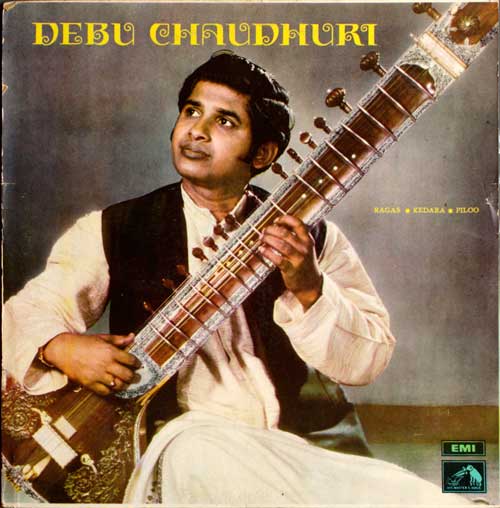
Debu Chaudhuri • Ragas Kedara & Piloo - P.1977


Debu Chaudhuri • Ragas Kedara, Piloo
EMI India - S EMGE 11004 - P.1977


Side A

A1 Raga Kedara - Alap and Masitkhani Gat - in Teental 19’36


Side B

B1 Raga Kedara - Razakhani Gat 5’54

B2 Raga Piloo - Teental 13’18


Here is another, not so exposed sitarplayer for your enjoyment.

There really are not that very many recordings on vinyl by him that I could find but this is one of the first that I knew of. He was a disciple of Ustad Mushtaq Ali Khan, an exponent of the Senia Gharana. I have posted one more recording by him before, recorded in 1987, ten years later than this one where he plays the ragas Bageshri and Maund. You can listen to it here


Thirtyfive year old Debabrata ‘Debu’ Chaudhuri is one of the most important sitar players of the day. Born in a business family of East Bengal, Debu had decided at a very early age that music would be the sole love and passion of his life. There was opposition from some quarters and scepticism from others, how could anyone without a traditionally musical background carve for himself a niche in the world of classical Music? But those who know Debu know that there was no room for doubt then or now. Debu has all that goes to make a musician great. He has the vision, the intuition and the grasp, above all his music is the creation of a man completely dedicated to his art.


Debu is a disciple of Ustad Mushtaq Ali Khan, an exponent of the Senia Gharana marked apart from other things, for its lineage which can be traced back to the great doyan of Indian music, Mian Tansen. The Guru-Shishya Parampara (the tradition of passing knowledge from master to pupil) of this school, was initiated by the great Sitar player, Amrit Sen. who was a direct descendant of Mian Tansen. Ustad Mushtaq Ali Khan represents all that is the best in not only his own school but also in the traditional Indian classical music, the intrinsic purity and lyricism of style, coupled with a perfection of technique. As a recognition of his invaluable contribution to the preservation and furtherance of Indian classical music, the Ustad was awarded the prestigeous Academy Award last year. Debu has had the proud privilege of learning sitar at the feet of this maestro.


Debu Chaudhuri has had many opportunities to display his talent both at home and abroad. At home he is an artiste widely acclaimed and has also been featured in the National Programmes. Abroad, he has had the distinction of being the first Indian musician to participate in the famous Montreaux-Vevey Music Festival in Europe and Shiraz Festival of Iran. He has also represented India in other International Music Festivals.

Debu stepped out of India for the first time in 1967 and since then has gone round the world half a dozen times. His recent tour covered among other countries, South America and the West Indies, which gave the people there their first ever opportunity to savour of Indian Classical music.

Apart from the general popularity, Debu's excellence in his field has attracted golden opinion from eminent musicologists all over the world. Dr. Nicholas Nabokav classes him as one of the finest musicians of the world. Dr. A. Danielou, Director, International Institute for comparative music in Berlin, has given him a place in the recorded U N Anthology of Oriental Music. At home Debu has been acknowledged as a musician of great lyricism and imaginative wealth.

What does he feel about his frequent trips abroad ? They are stimulating he feels, and above all he enjoys them because they give him an opportunity to acquaint his foreign audiences with the inherent beauty and mystery of Indian classical music.

Currently Debu is teaching instrumental music at the Delhi University and the Bharatiya Kala
Kendra, and he has a fine crop of promising students to his credit, some of whom have already been recognised in the music world.

This Album was recorded at the H.M.V. Studio, Calcutta, immediately after Debu's return from his last world tour. Accompanying Debu on the Tabla is Shyamal Bose, an artiste of All India Radio, Calcutta. Shyamal Bose, a disciple of Ustad Feroze Khan and Shri Jnan Prakash Ghosh is a virtuoso in his own right and belongs to the Farakkabad School of Tabla players.

from the original sleevenotes by Sujata Chauhan


Music ▼ +

Sunday, May 22, 2011

Padma Vibhushan Acharya Allauddin Khan • Sarod Recital


Padma Vibhushan Acharya Allauddin Khan
- Sarod Recital
Great Master Great Music - All India Radio Recordings
EMI India - ECSD 2757 - P.1976


Side A 

A1 Raga-Kaushi Bhairav Alap: Gat Vilambit and Drut-Tritaal 21'05

Side B 

B1 Raga-Hem Alap: Gat Drut-Tritaal 19'40


Some of the records I will post the following days are answers to several requests I have received from old friends and new. Some asking for flute and some for sarod and more sitar, and some being much more specific than that. Personally, like I have repeatedly said before I enjoy vocal music much more than instrumental but that does not mean I don't listen to any instrumental. I certainly do, and although neither sarod nor flute are any of my favourite instruments (these days more so because of my increasing tinnitus) I can anyhow sometimes find great enjoyment in both of them. 


I do however prefer reeds over flutes and bowed over plucked strings, especially when they are exploring the lower registers. It is maybe already evident from my previous posts of Bismillah Khan and Ram Narayan. And when it comes to plucked strings, Surbahar and Rudra Vina takes precedence over any sarod or sitar. All that said I still think this post is long overdue. Mainly because of the increadible influence on most of the North Indian classical music that the western audiences first came into contact with. Here is an old recording with an even older Allauddin Khan. At ninety years of age he was no longer in his prime but the recording is nevertheless most interesting, especially considering the scarcity of longer recordings with him. This is also a call to anyone that has any of the older recordings by him, when he was still at his peak, to come forward and share them. There are many who would eagerly like to wrap their ears around any such sounds. Anyhow here is another recording of the few that was released from the many treasures of the All India Radio Archives.


Allauddin Khan, also known as Baba Allauddin Khan (ca. 1881 – 6 September 1972), was a Bengali sarodiya and multi-instrumentalist, composer and one of the most renowned music teachers of the 20th Century in Indian classical music.

In 1935, he toured Europe, along with Uday Shankar's ballet troupe, and later also worked at his institute, 'Uday Shankar India Culture Centre' at Almora for a while. During his lifetime, he composed several ragas and laid the foundation of a modern Maihar gharana. Amongst his recording which are rare, the most important ones are those he recorded with the All India Radio in 1959-60.

He was the father of sarod maestro Ali Akbar Khan and Annapurna Devi, and the uncle of Raja Hossain Khan, as well as the guru of Ravi Shankar, Nikhil Banerjee, Vasant Rai, Pannalal Ghosh, Bahadur Khan, Sharan Rani and other influential musicians. He himself was a disciple of many great musicians, including Gopal Chandra Banerjee, Lobo, Munne Khan, and most importantly after a lot of struggle managed to become a shagird of the legendary Veena player, Wazir Khan of Rampur.


(snipped from wikipedia here)


Pt. Kanthe Maharaj-ji, U. Ali Akbar Khan, U. Allauddin Khan, Pt. Nikhil Banerjee and Pt. Kaviraj Ashutosh Bhattacharya, with a young Aashish Khan on tamboura - Kolkata 1952


It is my proud privilege to introduce to the young generation my guru, guide and father Padma Vibhushan Acharya Allauddin Khan.

This disc has been prepared from the Acharya's tapes obtained from All India Radio. Originally this music was recorded when he was in his nineties. This Long Play record is brought out by HMV so that it may be preserved as a cherishable memento of musical history rather than as a specimen of his great art. To this musical history the Acharya contributed so much, for the benefit of so many.

Comment on the record by 
Ali Akbar Khan

Acharya Allauddin Khan. 

One more vital link with our musical past snapped with the passing away of Acharya Allauddin Khan in 1972 Indeed, it marked the end of a great era - the era of giants in music. The centenarian Acharya was much more than a maestro, he was a phenomenon that just came off. His contribution to the enrichment of our musical heritage remains sui generis. He was steeped in the tradition of old masters. But his vast vision, his deep respect for western masters and his catholic understanding of their classical traditions lent a halo of universality to his art. In this sense, he was a reformist among conservatists and a conservatist among reformists.

The early decades of this century witnessed a near revolution in the time-honoured concept of instrumentation. And Acharya Allauddin Khan was the visionary who pioneered it. His fusion of gayaki, layakari and tantrakari, which enjoys such a tremendous vogue today, was no departure from the fundamentals of our tradition, but a unique combination of contemporary modes of instrumental expression without bias to any particular technique. This synthesis of tradition and experiment, of past achievements and future possibilities, lent a new dimension to North Indian instrumental music. The vitality of the stylisation, as also the versatility of its creator, is borne out by the fact that four of our greatest virtuosi are his disciples: his son Ali Akbar Khan, the inimitable sarodist, his daughter Annapoorna Devi, the undisputed Surbahar and sitar player, his son-in-law Ravi Shankar, the peerless sitarist, Timir Baran Bhattacharya and the incomparable flutist Pannalal Ghosh Adding to this impressive roll of honour are the Acharya's grandsons Ashish Khan, Dhynesh Khan, and a host of others.

Allauddin Khan's artistic intuition found its eloquent expression in many ways. The sarod was his first love — and last. But his virtuosity over a number of other instruments — string, wind, bow and percussion varieties — was truly astounding. The impressive line-up of ragas he created, such as Kaushi Bhairav, Hemant, Prabhakali, Hem Bihag and a host of others and also many talas, are his precious contribution to North Indian music. As a performing artiste, Acharya Allauddin Khan presented all that was best from the vast and varied Hindustani repertory and something more: the mystical element in music which in turn created a mood of spiritual awareness in the listener. This quality of detached intensity was probably inherent in the genius of the Acharys who, while yet a boy of eight, ran away from home to seek musical faith more than musical career. The saga of the sacrifices he made in the pursuit of his muse has few parallels in the world's musical history.

Born in 1862 in the village Shibpur (Tripura), now in Bangladesh, Allauddin Khan inherited his passion for music from his father, Sadhu Khan. After weeks of wandering in Dacca and Nawagram and days of starvation in Calcutta, the youngster at last found a great and magnanimous guru, the well-known musician Nanu Gopal, who promised to train him in vocal music. Pandit Nandlal, another guru, agreed to teach him tabla and mridang.

He devoted the next seven years of his life to vigorous and constant practice of vocal music. On the death of Nanu Gopal, Allauddin Khan decided to devote himself in future only to instrumental music. He joined the band of Habu Dutt, the well-known brother of Swami Vivekanand and learnt various instruments from him. Allauddin Khan's teacher in violin was Mr. Lobo, the conductor of the famous band at Eden Garden at Calcutta.


After three years of strenuous work, Allauddin Khan met Ustad Ahmed Ali, the famous sarod player, who accepted him as his pupil. After some years he left Ahmed Ali and went to the then Nawab of Rampur, a great patron of music. A descendant of Mian Tansen, Ustad Mohammed Wazir Khan Seniya. who was an eminent veena maestro in the court of Rampur. gave intensive training to Allauddin Khan to enable him to become an accomplished artiste. Allauddin Khan spent about thirty years of his life for this rigorous training. When he appeared at the concert platform, he was hailed as an outstanding sarodist throughout the country.


Allauddin Khan in 1929.

Allauddin Khan had formed the Maihar State Band, In later years he become the court musician of the State of Maihar. In 1935, he went on a concert tour to Europe with Uday Shankar's ballet troupe. He toured throughout the world and thrilled his audiences, for many years he continued to teach the poor musicians at Maihar and Allahabad and carried on his pioneering work in orchestration of Indian music.

A saintly personality, Acharya Allauddin Khan had dedicated himself and his music to Sharda Ma and was a strict vegetarian and disciplinarian. He regularly said his "namaz" or prayers five times every day. He was the first recipient of the President's Award in 1952 and Padma Bhushan in 1958, Desikottama from Vishwa Bharati in 1961 and Padma Vibhushan in 1971. But he remained essentially a lone artiste, unspoilt by name and fame, always immersed in the holiness of his art.
from the sleevenotes 


Still more to read here


Music ▼ +

Saturday, May 21, 2011

Nikhil Banerjee - Râga Monomanjari - Paris 1975


Le Sitar de Nikhil Banerjee • Râga Monomanjari 
Prestige de la musique extraeuropéenne, l'Inde vol.1
Disques Espêrance - ESP 155530 - P.1976 


Nikhil Banerjee, this time recorded in Paris 1975. I like very much his more contemplative and slower pace while developing the ragas, and this is one time we have to admit that the format of the LP is not ideal. We are left with beautiful music but still feel a little betrayed as it ends so fast. The longer format of the CD is of course better suited and still the LP was such a tremendous leap from the cut up pieces on 78 rpm's that had to extend over several sides. The affection remains because often we can only hear some of the best artists in recordings on older media. Hope you enjoy this record from this french series with a rather quaint and pretentious name but with the most lovely of all psychedelic covers of the seventies. We had a few of them here already, but there will be several more coming later from this series. Hope you enjoy!


Side A

A1 Râga Monomanjari, alap, gat - 23'15
dans le style dhrupad, raga du soir

Side B 

B1 Râga Manj Khamaj, alap, gat - 15'15
dans le style thumri, raga du début de la nuit

B2 Bengal Folk tune - 9'00


Music ▼ +

Friday, February 11, 2011

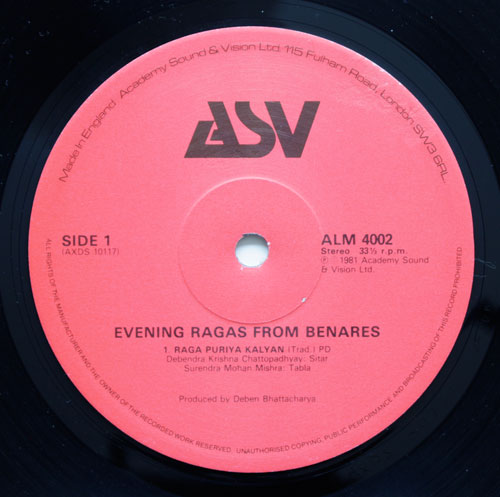
Evening Ragas from Benares - The Living Tradition - rec. Deben Bhattacharya


Evening Ragas from Benares - The Living Tradition
produced and recorded by Deben Bhattacharya in Benares in 1967
Academy Sound & Vision - ALM 4002 - P.1981


Side 1

A1 Raga Puriya Kalyan
Debendra Krishna Chattopadhyay,sitar
Surendra Mohan Mishra, tabla

Side 2

B1 Raga Pilu
Amiya Bhattacharya, surbahar
Narayan Chakravorty, tambura

B2 Raga Darbari
Narayan Chakravorty, vichitra vina


Here is an album produced by Deben Bhattachariya in the eighties of classical music for the stringed instruments Sitar, Surbahar and Vichitra Vina. The recordings are made much earlier some in private gatherings "mehfils" and in the homes of the musicians and like Deben Bhattachariya says in the liner notes you here and there hear: "the sounds of passing travellers and the cries of the vegetable salesman in the street outside combining to bring the atmosphere of India to the listener. As none of the musicians on this record are well known because they never recorded commercially, I highly recommend reading the liner notes (this time in english) as they not only reveal some valuable information on the performers, like that Debendra Krishna Chattopadhyay had his first musical training from his father, a highly respected Dhrupad singer professionally known as Panubabu for instance, but also gives a little glimpse into the philosophy of Deben's way of recording and what he wanted to preserve and transmit beside the well trodden path of commercialism. Hope you enjoy "being there".


Deben Bhattacharya • 1921 - 2001


Wednesday, February 9, 2011

Musique traditionelle de l'Inde - Recorded 1954 by Deben Bhattacharya


Musique traditionelle de l'Inde
Ragas de Bénarès recueillis et enregistrés en 1954 par Deben Bhattacharya
Bôite à Musique - BAM LD 014 - P.1964


Side A

A1 Mya Ki malhar (vina et acct)
A2 Bhairavï (flûte de bambou et tampura)
A3 Adana (sarangi et tabla)
A4 Chant de Mirabai (chant et accompagn' instrumental)

Side B

B1 Marubihag (2 sahnai, 2 duggis et svara)
B2 Bageshri (chant, sarangi et tabla)
B3 Puravi (esraj et tabla)


Here are some more recordings by Deben Bhattacharya. These must be some of the first recordings he ever made in India after having practiced in London on the expatriate Indian musicians there. The following are some of his own words about the hardships of financing the recording trip to Benares, culled from a quite interesting interview made with him in 1982 by Kevin Daly.

"I needed £80 for the tape recorder, about £20 for the transformer, and another £25 or so for 20 blank tapes to take with me, plus about £60 for a one way boat ticket to Bombay. Where was I going to get all this money? The Third Programme wouldn’t give me an advance, although I had a guarantee that they would take programmes when I came back. Then I met a lady called Sunday Wilson – extraordinary name – who was a producer for the overseas service. She commissioned me for six five-minute programmes. I got five pounds – no! – five guineas each, so that was £30.6.0 towards it! Some weeks after that, the poet Stephen Spender had started his new magazine ‘Encounter’, and had approached me to write an article on Indian poetry. We met, and when I told him I was going to India, he was very kind, and gave me an advance on two further articles. So that’s how I collected the money for my first recording trip: from Encounter, from Sunday Wilson, and from Harley Usill. Argo didn’t have much money, but they gave me £25, they paid for the Gaumont-British machine, and the tapes against future royalties." Read the full text here...

This record contains more of the classical repertoire. It was recorded in 1954 in Benares but was not issued until ten years after that under the sponsorship of l'Association Française des Amis de l'Orient, so I guess it consists of material that was not selected for publication by the Argo company. Liner notes are again in french...


vina

shahnai & duggi


esraj


Monday, January 24, 2011

Bhimsen Joshi - Sangeet Amrit - Sur Malhar, Marwa Shri, Marwa


Bhimsen Joshi - Sangeet Amrit
- Sur Malhar, Marwa Shri, Marwa
EMI India - ECSD-2879 P.1981


Side 1

Raga Sur Malhar
- Garjat Aaye - Khayal Vilambit - ektaal
- Badarwa barsan lage - Khyal Drut - tritaal


Side 2

Raga Marwa Shri
- Sab jagat ke guniyan ko sukh deejo daata - Khyal Vilambit - ektaal
Raga Marwa - Tarana - tritaal


Bhimsen Joshi - Ragas Pooriya, Durga


Bhimsen Joshi - Ragas Pooria, Durga
EMI India - EASD-1513 - P.1973


Side 1

Raga Pooriaya
- Pyare re gar lago - ektaal
- Gare ye ginat jaat - tritaal


Side 2

Raga Durga
- Too ras kan re - ektaal
- Chatur sugar balamwa - tritaal


Vasanta Charekar, Tablas


Bhimsen Joshi - Ragas Lalit Bhatiyar - Kalashree


Bhimsen Joshi - Classical - Ragas Lalit Bhatiyar , Kalashree
EMI India - EASD-1501


Side 1


Raga Lalit Bhatiyar
- O Kartar - Teen Taal

Side 2


Raga Kalashree
- Dhan dhan mangal gao - Jhap Taal
- Dhan dhan bhag suhag tero - Drut -Teen Taal