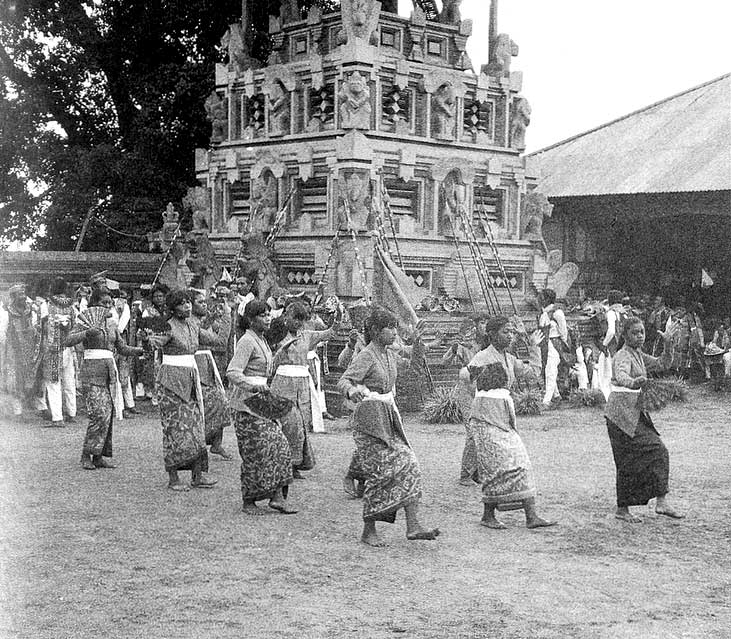
The Gamelan Orchestra - Music from Bali
- Record Two
Argo Records - ARS 1007 - P.1952
- (XB 100-3, 4)
- (XB 100-3, 4)
Gamelan orchestra from Pliatan, Indonesia led by Anak Agung Gde Mandera recorded live at Wintergarden Theatre, London 1952
This LP was also released as: [Westminster XWN 2210? - P.1957] = Argo Records - RG-2 - P.1952

Side A
2-A1 Kebiar 8'49
2-A2 Oleg 8'44
2-A3 Barong 5'32
Side B
2-B1 Djanger, Ende, Baris 18'25


This is the cover of Record One that is already here in a previous post and to be quite frank I never expected to find Record Two, but here it is! It did however cost me a pretty penny and lot of determination to be able to share it with you and present it here. It makes me very happy and I hope you can share my joy! This copy is in wonderful condition and the photography of the sleeve is a joy to behold. There is not much to add to this post as almost all I know about it is already in the previous post!
Music From Bali - Record Two
It is a commonplace of musical history that Claude Debussy was considerably influenced by the Gamelan which appeared at the Exposition Universelle in Paris during 1889. But, with the exception of a number of Dutch musicologists — notably Dr. Jaap Kunst—few Western music lovers have any knowledge of Balinese music and the opportunities of hearing it-such records that do exist being almost unknown in Great Britain and the U.S.—have been few. Indeed, so far as London and New York are concerned, the recent appearance of the Gamelan from Pliatan, Indonesia, under its brilliant director, Anak Agung Gde Mandera, is the first opportunity the music lover has had of assessing this fascinating and highly organised musical art. Unlike much Eastern music, Western ears have no difficulty in appreciating the music of Bali, and it is certain that with the issue of these, the first long playing records, made in collaboration with the Indonesian Government, many will wish to become more closely acquainted with what, is, quite clearly, a folk art in the highest stage of development, In the opinion of those but qualified to judge these records present an adequate survey of Balinese music as it is today and can safely be said to serve as a comprehensive introduction to this neglected-so far as Western ears are concerned-branch of music.

Kebiar. This dance, created during the early thirties by a famous dancer from South Bali, inspired Anak Mandera to compose what many consider to be one of the most beautiful pieces co contemporary Balinese music. Following a bold statement of the principal motif a gentle swaying accompaniment is heard underlined, as it were, by the lower gong. Working gradually towards a climax the main theme is restated in augmentation while the accompaniment becomes more excited breaking into an ostinato figure accentuated by syncopated chords on the barong. This fine example of the Kebiar was awarded the all-Bali prize in 1938.

Oleg. As in the preceding work this music accompanies a modern dance, in this instance one from North Bali. It consists of a simple melody reiterated on the Hatong or Balinese flute accompanied by a variety of complex rhythmic patterns played on the various sections of the Gamelan with a bewildering subtlety of tone colour that is an outstanding feature of this branch of Indonesian music.

Barong. Is one of the many primitive dance-plays that are highly thought of by the Balinese. Barong is a mythical animal, a fantastic lion, who protects the Balinese against evil. He fights against Rangda. Queen of the Witches, symbol of darkness. Illness and death. The music consists, in the main, of a constantly repeated figure against which the roan of the lion are heard. At the death of Rangda the gamelan bursts into a jubilant statement of the main theme bringing the work to a close on a note of triumph.
Djanger, Ende, Saris. The first of these three dances. Djanger, is a simple folk tune sung in unison by boys and girls. It is a typical example of its kind. The second, Ende, is a fighting dance. A sham duel is fought out to the stimulation of a small gamelan consisting of kendang, small gong, and tarompet. The fighters are dressed in grotesque costumes and armed with roatan sticks. Although intended as a friendly sport there have been instances of the fighters continuing to the death. The third, Baris, is a short dance-play, in which Ardjuna, the hero of the Mahabhara epic is disturbed, while fasting, by heavenly nymphs, sent by the Gods to test him to see whether he is strong enough to become their champion against the Demon King. Alarmed, the Demon King sends a wild boar against Ardjuna who kills it. His claim is disputed by the God Shin. To settle this dispute Ardjuna fights Shiva in his human form and on winning the contest is proclaimed by the Gods.
Cyril Clarke.
quoted from the record sleeve
Technical Credits. Recorded during actual performance at the Winter Garden Theatre in association with Mr. Derrick de Marney for and on behalf of The Indonesian Government. The original magnetic tape recording and transfer of the record to disc masters was mad. by Alec Herbage, Harley Usill and Cyril Clarke. The sleeve and label was designed by Victor Ross. Photographs by Dennis de Marney.