Showing posts with label Indian Classical. Show all posts

Wednesday, June 15, 2011

Ustad Zia Fariduddin Dagar • Chandrakauns in Stockholm 1981


 Ustad Zia Fariduddin Dagar 
• Chandrakauns


Recorded 25th September 1981 in Stockholm
Skivbolaget Urspår - Origo 1002 - P.1984


Side A

A1 Chandrakauns (I) 22'33


Side B


B1 Chandrakauns (II) 24'13


But here Chandrakauns is served in one piece at 46'36 


Happy Birthday!
Ustad Zia Fariduddin Dagar (born 15 june 1932)

Nuances of the notes

Ustad Fariduddin Dagar is one of the oldest living exponents of the Dhrupad and his music makes serious demands on the listener, writes Deepa Ganesh after a chat with the maestro.

Contemplative, unhurried and probing music.
"AGAR aap Hindi bol nahin sakte, mere baat kaise samjhenge?" snaps Zia Fariduddin Dagar, the oldest living exponent of the Dhrupad tradition. "Samajh sakti hoon, par theek se bol nahin paati," I meekly offer. "Accha theek hai...," he muttered to himself, with an unmistakable emphasis on the word theek. Nothing misses him.

He is an authority on the Dhrupad; on all classical forms of music, in fact, including Carnatic music. As the conversation progresses, you learn he is in tune with everything — from politics (something he is very condescending about) to the music scene (his life's breath).

A family's heritage


Dhrupad, the oldest existing form of north Indian classical music, has become synonymous with the Dagar family. So much so one wonders if the form existed before them. In fact, any discussion on the Dhrupad remains incomplete without bringing the Dagars into it.

Dhrupad, which represented the noblest style in Indian vocal art, was patronised by royalty. But during the first half of the 20th Century, the all-pervasive Khayal took over and Dhrupad became the preserve of a few families. The democratisation of royalty also led to decline in patronage, throwing artistes into financial hardship and severely impacting the age-old guru-shishya parampara.

Since the mid-1970s, as a result of broader re-evaluation, Dhrupad has enjoyed a revival. With the younger members of the Dagar family, disciples, and other families, this extremely contemplative form of music is steadily making an effort to reclaim its position at the centre of the Indian musical tradition.

Dhrupad was originally a Hindu tradition. Most compositions are also on Hindu deities. But interestingly, the tradition has come to rest with Muslim musicians.

Explains Ustad Fariduddin Dagar Saab: "My ancestor Baba Gopal Das was a Hindu. My ancestors were court musicians in the darbar of the Mughal king Muhammed Shah Rangeela. It was the custom to wind up the performance by accepting paan offered by the king. When my ancestors did so, there was a huge uproar in the community: `by accepting the paan you've become Muslim'. `So be it,' said my ancestor," he narrates nonchalantly.

With the coming of Khayal, a tradition that makes for easier listening, in the early half of the 20th Century, Dhrupad moved to the periphery.

Losing ground?


Why did the Dhrupad lose ground? The Ustad takes umbrage at this, insisting it was never unpopular. In fact, in the absence of royal patronage, musicians gave up singing the Dhrupad, because they did not have anybody to take care of them. "When my father passed away, I was a young boy. And the king, who was my father's patron, was out of power. But when he heard of my father's death, he sent his men to see how the family was." From that day till his death, the king bore the expenses of the family. "That was the commitment. But I can't expect the same to happen in my case. I'm sure after my death, my family will be thrown out of the house they have given me in Bhopal."

The maestro is furious with the state that does not try to preserve or protect its culture. "Politicians aren't capable of any good," he says. "What has your State done to take care of its musicians? Adil Shah of Bijapur was such a big poet. We sing so many of his poems. Have they preserved his works? He has done so much for music, architecture and paintings."

Ustad Fariduddin Dagar doesn't think much of Khayal, but doesn't reject it totally either. "Khayal also has a tradition. But now there is nothing in place; everyone plays to the gallery. The early Khayal singers had a firm grounding in Dhrupad." The Ustad, legendary for his total involvement, famously said: "When I close my eyes and begin to sing, there is only darkness... slowly, light comes, then the beginnings of colour." He explains how the musician is alone with the "vastness of the self" and musicality lies in contemplation. Like in other Indian classical forms, the alaap is the entry point to the raga. But Fariduddin Dagar says that if a listener fails to comprehend the alaap, he should be able to do so at least with the lyrics.

Difficult to learn

The singer's treatment of the composition should evoke the mood of the raga. "You can sing for hours, but you should be able to grab the soul of the raga."

Due to its strict adherence to purity, learning Dhrupad is very difficult. Is that what makes people think Dhrupad is rigid? "According to me, there is immense freedom. Khayal is like the romantic period in music," he elucidates. Though there have been master composers like Mozart and Brahms in the West, Bach is still the colossus. "Bach's music is on a different scale. There is no romance in his music. It is spiritual. And that is true of Dhrupad too."

In fact, there are many big-time Khayal musicians who trace their inspiration back to this grand old form. Some musicians even talk of a Dhrupad element in their rendition of Khayals. "Everybody now wants to claim the Dhrupad style. Thirty years ago, when it was forgotten, nobody talked about it as their source," says the Ustad indignantly.

"You can't go to a Dhrupad concert like you go to the films. When you set out to please your audience it doesn't work. A musician has to feel convinced about what he is singing, be believes.

How does one explain the West's penchant for Dhrupad? Is it an extension of its fashionable affinity for everything spiritual? For the Ustad, whose life centres on Dhrupad alone, this is too complicated. "They are very curious about it. But they like to listen to the alaap and not pada. They go into minute details and it's very heartening to perform for them," is his simple position.

This makes an interesting comparison to what Alain Danielou, a Western scholar of Indian music, has to say about Dhrupad: "Its verbal and emotional dignity is conveyed by slow, elephantine movements and with utmost economy of flourishes and decorations."

You know what that means when the maestro sings. His music is sensuous, subtle, and intensely spiritual. As he unfolds the notes of Shuddh Sarang, you know there is no escape except to surrender to it completely.

In the typical contemplative, unhurried, probing fashion, he delves into the nuances, note by note. The amazing flexibility of his voice, the exuberance, and sheer joy of the experience of singing makes such exacting demands on the listener that it leaves one exhausted.


article by K. Murali Kumar 
borrowed from The Hindu 2005.02.20 here


Ustad Zia Fariduddin Dagar, with Anita Livstrand, tambura

I hope you all appreciate this recording, several friends were involved in this production and to my knowledge it has never been reproduced on CD. The picture above may be from the same concert as the recording since it was taken in September 1981. The record was produced by Hans Isgren and engineered by Peter Hennix at his private loft where many wonderful concerts of Indian classical music took place. I hope you will enjoy it. Again like a recording of ZMD that i posted some days ago, this also had an unfortunate split in the middle to fit on the two sides of an LP. No such scars remain as that cut has now been "healed" and the concert is again "uncut".

record inlay leaf...


Music ▼ +

Thursday, June 9, 2011

Ustad Zia Fariduddin Dagar • Raga Bhimpalasi


Ustad Zia Fariduddin Dagar 
• Raga Bhimpalasi
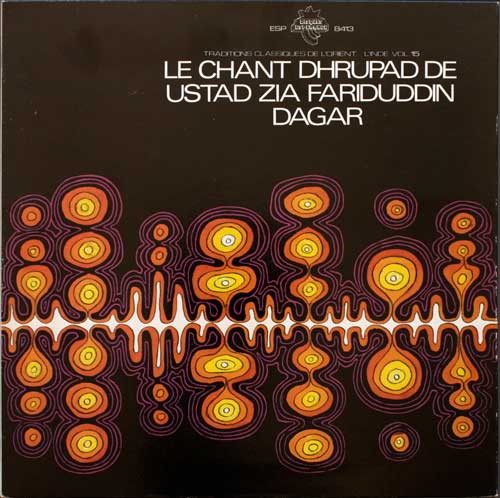
Le Chant Dhrupade de Ustad Zia Fariduddin Dagar
Traditions classiques de l'Orient - l'Inde. vol.15
Disques Esperance - ESP 8413 - P.1985


Side A


A1 Bhimpalasi - alap, jor (I) 25'11


Side B


B1 Bhimpalasi - jor (II), jhala 11'05
B2 Bhimpalasi - bandish - chautal 14'44


Manik Munde, Pakhawaj

I guess no one will complain if I continue to post recordings of the Dagar family, so here is a great recording from the early eighties of Farid, as he was affectionately known by some of his local students here. Hopefully this spree of Dagar recordings will also attract some new ones, so if you have something laying around, please share it with us. I will post one more locally produced record with Fariduddin recorded in the eighties. Later I will also try to locate what private tapes there are laying around. I have a few and there must be many more. A consorted effort here would be something very joyous, at least to me. What do you say? Anyhow I feel certain that you will enjoy this one!

(thanks WD, for your falcon eyes)


Zia Fariduddin Dagar (born 1932) is an Indian classical vocalist in the Dhrupad, the oldest existing form of north Indian classical music (Hindustani classical music) and part of the Dagar family of musicians. He taught at the Dhrupad Kendra, Bhopal, along with his elder brother, Ustad Zia Mohiuddin Dagar for 25 years. He was awarded the 1994 Sangeet Natak Akademi Award in Hindustani music-Vocal by Sangeet Natak Akademi, India's National Academy of Music, Dance and Drama

He was born in Udaipur, Rajasthan in India on 15 June 1932, where his father, the great Ustad Ziauddin Khansahib was the court musician of Maharana Bhupal Singh of Udaipur. He was taught dhrupad vocal & veena by his father. After his father’s demise, he continued learning under his elder brother, Late Ustad Z M Dagar, the foremost Rudra veena player of 20th century. Ustad Zia Fariduddin Dagar represents the 19th generation of the musical tradition of the Dagar family that is believed to have preserved and nurtured Dhrupad for 20 generations.

Ustad Zia Fariduddin Dagar has done a lot for popularizing dhrupad music by his numerous concerts and workshops. He has performed widely in India and abroad, and received the Tansen Samman from the Madhya Pradesh government and the Sangeet Natak Akademi Award. In 2005, he was presented with the Lifetime Achievement Award by the North American Dhrupad Association.
He has a remarkable command over microtones (swara-bheda) and various gamakas, and is noted for his gradual development of alap through vilambit, madhya and drut laya (slow, medium and fast tempo). He is probably the only person alive to be able to demonstrate all the five geetis mentioned in the Sangita Ratnakara namely, Shuddha, Bhinna, Gaudi, Sadharani(which is dagarwani of today) & Vegasura (which is popular in south India). He is the most influential dhrupad vocalist in India after the senior Dagar Brothers (Ustads N. Moinuddin & N. Aminuddin Dagar).

By 1980, he had virtually settled down in Austria teaching Dhrupad in Austria and France. Once, during a visit to India, one of his disciples, the filmmaker, Mani Kaul came to him and pleaded with him to provide the background score for a film, The Cloud Door (1994) he was making on Madhya Pradesh. During the making of the film, they spent over two months in Madhya Pradesh, a lot of time in Bhopal,
and Ustadsahib agreed to move back to India and to take charge as the Guru at this Gurukul. He taught dhrupad for 25 years at this Dhrupad Kendra, under the Ustad Allauddin Khan Music Academy, Bhopal, to students like the Gundecha Brothers.

Nowadays, he stays & teaches at the Dhrupad Gurukul near Panvel, which was built by his elder brother Ustad Z. M. Dagar. He continues to perform widely in India and abroad.

snipped from Wikipedia, read the full text here 


Music ▼ +

Monday, June 6, 2011

Ustad Nasir Aminuddin Dagar • Mian Ki Malhar, Bhairav, Bharavi


Ustad Nasir Aminuddin Dagar 
• Raga Mian Ki Malhar, Raga Bhairav, Raga Bhairavi.
EMI India - HMV EASD 1420 - P.1983


Side A

Raga Mian Ki Malhar 25'58

Side B

Raga Bhairav 18'23
Raga Bhairavi 10'13


Vithaldas Gujrati, Pakhawaj


Dagar is not merely a family name but a whole tradition. A descendent of Baba Gopal Das Dagar and Ustad Behram Khan, and the second son of the illustrious Ustad Nasiruddin Khan, Ustad Nasir Aminuddin Dagar was born at Indore in 1923. His training started at a tender age of 5 years. First 8 years of his 37 years of learning period were spent under his father, and the last 19 years under his elder brother, Ustad Nasir Moinuddin Dagar, whom he regards as his main Guru and who died in 1966; he spent the intervening 10 years' learning from his uncles, Ustad Riyazuddin Khan of Jaipur and Ustad Ziauddin Khan Dagar of Udaipur. His belief that he continued learning from his brother until he died is a testimony to his devotion and understanding of the in-depth and essence of learning.

Together as the legendary “Dagar Brothers”, Ustad Nasir Moinuddin Dagar and Ustad Nasir Aminuddin Dagar became the most popular and effective Dhrupad Dhamar singers of their time, and were jointly responsible for popularising, revitalising and uplifting the Dhrupad Dhamar tradition, which had slowly started dwindling with the spread of Khyal gaikee and the infiltration of commercialism in classical music.

Ustad Nasir Aminuddin Dagar has travelled widely all over the world. He visited the USSR and Japan in 1971 with his elder brother, and participated in the Berlin, Venice and the UNESCO International Music Festivals in 1964. European audiences were overwhelmed by their soul stirring performances and the press acclaimed them. Ustad Nasir Aminuddin Dagar gave solo recitals in Europe and the USA in 1971, Iran in 1976 at the Shiraz Festival. Italy in 1978 and the U.K. at the prestigious “India Festival” in 1982. Wherever he sang he cast a hypnotic spell over his listeners with the elegance and intricacies of his alapchari and the grandeur of Dhrupad.

Ustad Nasir Aminuddin Dagar is truly a saint musician. Meeting him and talking to him is a divine experience. Listening to his music is a lesson in spirituality. It makes you unaware of your surroundings. For a while, one may admire the academic excellence of his music, but soon one is lost in the effect created. One is then at peace with oneself. The purity of Akar, the microtonal accuracy, the rasa and the roop of the Raga, the disciplined and the purposeful elaboration or “barhat”, the elegance of gamak, meend, soot, lahak and andolan etc., the structural beauty of the composition, all help in attaining this experience. His rendering is a clear testimony of his traditional upbringing, years of hard work, clean and pure life which should be a lesson to posterity.

Side one of this album contains the seasonal raga Mian-Ki-Malhar, and side two the morning ragas Bhairav and Bhairavi. Alapchari in all three ragas is done with precision and order maintaining “roop” of the respective ragas throughout with characteristic phrases and microtonal accuracies. The dhrupads of Mian-Ki-Malhar, ”Ayi Hay Ghata Umad Ghumad” in Chowtal, of Bhairav, “Shiva Adi Mada Anta” in Jhamptal and the Dhamar “Kunjana Men Khelata Hay Phag” in Bhairavi have all been sung with utmost clarity, maintaining the structural dignity of the compositions. The overall effect is highly satisfying. Pakhawaj accompaniment provided by Vithaldas Gujrati is extremely competent, and appropriate throughout.
snipped from the notes on the sleeve


Music ▼ +

Sunday, June 5, 2011

Ustad Rahimuddin Khan Dagar - AIR - 1960


Ustad Rahimuddin Khan Dagar 
• Rageshri-Kanhara AIR - 1960
EMI India - HMV PMLP 3069 - P.1990


Side A

Raga Rageshri-Kanhara : Alap (1960) 27'26

Side B

Raga Rageshri-Kanhara : Alap (1960) 13'35
Dhrupad: Ganga Jata Shiv (1960) 14'16


Ustad Rahimuddin Khan Dagar (1900-1975) was the second son and student of Allabande Khan and one of the outstanding dhrupad singers of our times. He was also well-versed in sangeeta shastra. He was associated with the courts of Jaipur, Alwar and Indore. His son is Fahimuddin Khan Dagar, another well-know dhrupad exponent.

Reference: Sangeetagyon ke Samsmaran by Vilayat Hussain Khan 
(Sangeet Natak Akademi, 1959)

Ustad Rahimuddin Khan Dagar, was one of the most eminent scions of an illustrious house of musicians. Dagar Family traces its lineage to Miyan Tansen, the court-musician under the patronage of the Moghul emperor, Akbar. Miyan Tansen is universally acknowledged as the maestro, who pioneered the contemporary “Dhrupad-Dhamar parampara”, which marked the genesis, evolution and development of the Hindustani “Sangeet Paddhati”, the traditional musk of north India, both vocal and instrumental. And the Ustad carried on the precious heritage and enriched it with dedication and justifiable pride till his death at 75.

Son of the maestro, Ustad Zakiruddin Khan Dagar, one of the ail-time great “Dhrupadiyas” of yesteryears, melody and rhythm coursed through the Ustad’s veins. His father was also his guru, whose magic touch backed by the son's epochal “riyaz”, helped the youngster to rise to enviable fame and glory. He was a recipient of the Padma Bhushan and a string of other accolades and distinctions.

The Ustad was endowed with a ringing, sonorous voice, and his style carried authenticity and evidence of erudition and scholarship. His ‘Gayaki’ revealed a majestic pace and benign expression. He had an uncanny knack of winning over his audiences as much by his gay, ebullient manner as by his profound, sublime music. With typical dignity and poise, the maestro projected his chosen “Ragas” by means of smooth and soothing “Alap”, while trenchant rhythms and pounding accents characterised his Dhrupad-Dhamar renditions.

Ustad Rahimuddin Khan Dagar passed away at New Delhi on November 20th 1975.


The Music

Raga Rageshri-Kanhara, This “Raga” sounds like an ingenious fusion of two separate but well-known melodies, both rendered in the second quarter of the night. He has invested his chosen theme with all the familiar virtues- musical, rhythmical and aesthetic. It is first presented in prefatory “Alap” and then through a “Dhrupad” composition, an invocation to Lord Shiva.
 culled from the notes on the record sleeve


Music ▼ +

Sunday, May 29, 2011

Jamaluddin Bhartiya • Two Ragas


Jamaluddin Bhartiya 
• Two Ragas 
Opus 3 - 8004 - P.1980


Side A 

A1 Nat Bhairav 24'04


Side B

B1 Sindhu Bhairavi 24'51


Rashid Jamal, tabla
Razia Ragini, tanpura

Recorded March 24-25 1980 in the hall Universel, Sufi Movement
Katwijk, Holland.


Here is a record that I had hoped would satisfy some of the urges of a senior editor at Panchamkauns who had an unquenchable thirst for the Ustads vocal meandering. He wanted almost desperately to hear him sing along with his sitar (which he supposedly does much better than Vilayat Khan) but unfortunately I cannot hear as much as a hum from the maestro. I'll post it anyhow and if someone else has a recording where we can hear him bursting into vocals, please share it with us here. There is one on Space Records SP 4, recorded in Amsterdam 1972 that I have not heard that may be a possible candidate. 


The Artist

As it is very often the case in India, Jamaluddin Bhartiya comes from a family which has been devoted to music for centuries. It is his father Ustad Abdul Qadar Khan, a court musician in Sailana State, who introduced him to music. Then he recieved guidance in vocal music from the famous Ustad Amir Khan. But his main interest was the sitar; therefore he required Pandit Ravi Shankar to teach him, and had the honour of becoming his first disciple.

After having built a flourishing career as a concert and radio artist, Jamaluddin Bhartiya embarked on a new chalange; that of bringing the richness of the Indian musical tradition to the west. With the blessing of his guru Ravi Shankar, he established the Tritantri Vidya Peeth, a school for the teaching of Indian music and culture. Branches have been opened in Holland and Switzerland, and they attract each year numerous students from many countries.

As a performer, Jamaluddin Bhartiya is extremely appreciated, both in India and abroad, for the beauty aud profoundness of his style, in the pure tradition of the gayaki ang, as well as for the striking dexterity of his technique.

On this recording, he is accompanied by Rashid Jamal on the tabla, and by
Razia Ragini on the tanpura.


Music ▼ +

Monday, May 23, 2011

Kesar Bai Kerkar - LP reissue of old plates - P.1963


Surshri Kesar Bai Kerkar 
- Raga Lalat - Raga Malkauns
EMI India - EALP 1278 - P.1963 


A1 Ghatan Lagi Rain - Lalat - Teental 4'19
A2 Haan Re Daiya - Todi - Teental 3'23
A3 Devi Durge - Kukubh Bilawal - Jhaptal 4'33
A4 Mare Dere Aao - Desi - Teental 4'38
A5 Jaat Kahan Ho - Bhairavii - Deepchandi 3'31

B1 Preeetam Saiyan - Lalita Gouri - Teental 4'43
B2 Nevar Baju Re - Nat Kamod - Teental 4'22
B3 Maan Na Kari - Goud Malhar - Teental 4'23
B4 Main San Meet - Malkauns - Teental 4'10


There are so many wonderful artists I would have loved to post already and after the comment I made in previous post it sometimes feels as if they are all overdue. It will come as a surprise to no one that one of my first loves of Hindustani female vocal was Kesarbai introduced to me by a very good friend who passed on already long ago. I may have mentioned her already in one of my first posts. Yet, I have not had the decency to post anything by her so far. This record, or at least the music on it, may already be in possession by most of you, and so it should, but in case of an unfortunate possibility that it has still been missed by one or two, this shortcoming has now at long last been remedied.

This is one of the very first records I heard of any Hindustani vocal and that I have played the most in seventies.  Very soon, I also just have to fix the flagrant Paluskar deficiency we have been suffering from here.


Kesarbai Kerkar
(b Goa, 13 July 1892; d 1977).

North Indian vocalist. She was attracted to devotional music as a child and began her training at the age of seven with Abdul Karim Khan of the Kirana gharānā. She later studied with Barkatullah Khan, the court sitār player in Mysore and Patiala, and Bhaskar Rao Bakhle of the Agra gharānā, and, most significantly in terms of musical style, with Ustad Alladiya Khan (1920–46), who stipulated that she should always sing with him at concerts. She remained with him until his death in 1946, when her solo career began. She inherited the style of Alladiya Khan, including melismatic tān in performances of khayāl and a preference for improvisation in Tīntāl. She also sang thumrī.

Kesarbai in Concert
Padharinath Kale, harmonium, & her brother Pt. Yeshwantrao Kerkar, tabla


She was dubbed (Sur śrī) in 1938 by Rabindranath Tagore and was known thereafter as ‘Queen of Music’. In 1953 she received the President’s Award for Hindustani Vocal Music from the Sangeet Natak Akademi, and in January 1969 she was awarded the Padma Bhushan by the Government of India.


Music ▼ +

Saturday, May 21, 2011

Nikhil Banerjee - Râga Monomanjari - Paris 1975


Le Sitar de Nikhil Banerjee • Râga Monomanjari 
Prestige de la musique extraeuropéenne, l'Inde vol.1
Disques Espêrance - ESP 155530 - P.1976 


Nikhil Banerjee, this time recorded in Paris 1975. I like very much his more contemplative and slower pace while developing the ragas, and this is one time we have to admit that the format of the LP is not ideal. We are left with beautiful music but still feel a little betrayed as it ends so fast. The longer format of the CD is of course better suited and still the LP was such a tremendous leap from the cut up pieces on 78 rpm's that had to extend over several sides. The affection remains because often we can only hear some of the best artists in recordings on older media. Hope you enjoy this record from this french series with a rather quaint and pretentious name but with the most lovely of all psychedelic covers of the seventies. We had a few of them here already, but there will be several more coming later from this series. Hope you enjoy!


Side A

A1 Râga Monomanjari, alap, gat - 23'15
dans le style dhrupad, raga du soir

Side B 

B1 Râga Manj Khamaj, alap, gat - 15'15
dans le style thumri, raga du début de la nuit

B2 Bengal Folk tune - 9'00


Music ▼ +

Tuesday, May 17, 2011

Ustad Mahmud Mirza - Concert in London 1975


Ustad Mahmud Mirza 
• Rag Darbari
• Rag Kafi 


Tangent - TGS 123 - P.1976


Side A

A1 Rag Darbari, alap, jor 24'31

Side B

B1 Rag Darbari, jahla 8'13
B2 Rag Kafi, gat 17'10


Here is a record that I don't think has gotten the attention it deserves, I don't think it was ever re-issued. The recordings were made in London in 1975 and was one of two LP's with indian music on the label Tangent, that in my opinion had a small but very good catalogue. I will come back to some of the other releases later among them two Mongolian LP's and the 6 LP from Music in the World of Islam Box.


Mahmud Mirza


In London 1975


Ustad Mahmud Mirza was born in Delhi in 1935. At an early age he was taught the sitar by his maternal uncle Ustad Hyder Hussein Khan who initiated him into the Seniya gharana an instrumental tradition founded by the descendants of Miyan Tansen the court musician to Akbar the Moghul emperor.

He was later initiated into the Kirana gharana by his second teacher the vocalist Pandit Jiwan Lal Mattoo; a student of the renowned vocalist Abdul Wahid Khan, with whom he studied the ragas in depth over many years. Mirza first performed in public when he was 11 and at the age of 13 he was the youngest musician ever to be accepted on the staff of All India Radio.
In the late sixties Mirza made his first appearance in London where he now resides. He has performed in many of the famous concert halls of Europe and the US and is known as an outspoken defender of the pure tradition in an age when this art form has suffered due to the trend of commercialisation.

In Granada 2009

On his webpages here, where the above biographical note is snipped from, there are several videos and 6 more CD's of his music to listen to.


Music ▼ +

Wednesday, March 30, 2011

The Madurai Brothers - Nadhaswaram


M.P.N. Sethuraman & M.P.N. Ponnuswamy - Nadhaswaram
EMI Columbia - S-33 ESX 6086 - P.1974


Side A

A1 Parath Para — Jaganmohini
A2 Ninnu Vina — Navarasa Kannada

Side B

B1 Nathajana Pari — Simmendra Madhyamam
B2 Maadu Meikkum Kanna — Desh
B3 Ayi Giri Nandhini — Vedham


Thevur S. Rajarathnam, Thavil
Thevur S. Santhanam, Thavil


It has been brought to my attention that I have been posting far too little Nagaswaram music lately, so here on public demand is another, to my ears very good record again with The Madurai Brothers. I promise I will post some more as soon as the ones waiting in line does not complain about being pushed aside...


Friday, March 11, 2011

Madurai Mani Iyer - Carnatic Classical Vocal - 1965


Madurai Mani Iyer - Carnatic Vocal Telugu & Sanskrit Classical


EMI Columbia 33 ESX 6004 - P.1965


Side A

A1 Seethapathe Kamas 11'45
A2 Samjavaragamana - Hindholam - Telugu 9'10

Side B

B1 Kamalambam Hajare - Kalyani - Sanskrit 20'35


T.N. Krishnan, violin
Vellore Ramabhadran, mirudhangam


Another of my beloved South indian male voices is Mani Iyer, Madura in this case also indicating "sweet" and not only a reference to the city Madurai. He is indeed sweet and his intense glow is also something that feeds me a lot of energy! Hope you like him as much as I do! This post is in celebration of my new grandchild a boy born yesterday, he already has an older sister so I guess he will be fine even though it is a hard world! When celebrating life I think only Carnatic music works well enough for me so this is a very special album ;-)

The "sweet voice" of Madurai Mani Iyer in concert!


Madurai Mani Iyer (Tamil: மதுரை மணி ஐயர்) (October 25, 1912–1968) was a Carnatic music singer, who was famous for his unique style. He was one of the most highly celebrated carnatic vocalists during the first half of the 20th century. He was renowned for his adept skills at singing kalpana swarams, neraval, and raga alapana. His music continues to be highly regarded today.

Here are some links from this webpage, dedicated to him and his art and with lots of information and anecdotes!