Showing posts with label Rwanda. Show all posts

Monday, April 25, 2011

Music From Rwanda - recorded 1954-55 by Denyse Hiernaux-L'hoëst


Music From Rwanda

Recordings and documentation by Denyse Hiernaux-L'hoëst 1954-55
Photography by Jaques J. Maquet

In collaboration with the Royal Museum of Central Africa, Tervuren 

An Anthology Of African Music 2
Bärenreiter • Musicaphon - BM 30 L 2302 - P.1965


Side A

Tutsi

No. 1 Rukina, Seven drums of the mwami with song. - Nyanza 5'02
No. 2 Song with handclapping - Rurambo 3'01
No. 3 Umuhara, Song of the spirits - Astrida 2'20
No. 4 Guhindura - Cyinkanga (Nyanza territory) 2'36
No. 5 Muberule, Board Zitehr - Rurambo 2'46
No. 6 Kana, name of a woman - Astrida 3'06
No. 7 Chandali, Mens song with zither accompaniment - Astrida 3'07
No. 8 Ikimanura, Arrival of the Tutsi - Nyanza 3'33


Side A total time 25'31


Side B


Hutu

No. 9 Mugore W'Ingare, the difficult woman - Astrida 2'08
No. 10 Induru Ni Ndende, the war cry is long - Astrida 5'04
No. 11 Ikondera, song of the brides friends - Astrida 1'53
No. 12 Ntawundi mwana nkibyara ndakuze, he can no longer procreate, he's to old - Astrida 3'22
No. 13 Kubangurira, Pastoral song - Astrida 1'54
No. 14 Ingare, the shrew - Astrida 2'05
No. 15 Agasambi, the royal crane - Astrida 3'15
No. 16 Nshoz' Uruyange, praise of an army corps - Musha 1'57
No. 17 Ibare, in praise of a chieftain - Cyinkanga (Nyanza territory) 2'33


Side B total time 29'42


We had three records before from Rwanda, all published by Royal Museum of Central Africa, Tervuren and the volume in this Unesco series is a collaboration with that same Museum. 
Rwanda Map


Rwanda Map (detail)


Hutu dance of the brides friends
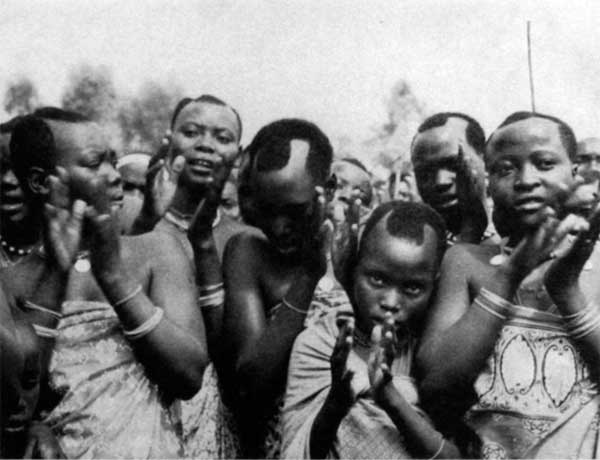
Hutu dance of the brides friends

Hutu musical bow

Hutu vertical flute

Hutu vertical flute

Inanga


Tutsi. Seven drums of the Mwami


Tutsi. Umuhara song of spirits


Twa. Makondera orchestra

Twa song and dance

Young Tutsi singer


Music ▼ +

Wednesday, April 20, 2011

Bärenreiter Musicaphon - Discography # 3 - An Anthology of African Music

An Anthology of African Music
Bärenreiter • Musicaphon


BM 30 L 2301 The Music Of The Dan
BM 30 L 2302 Music From Rwanda
BM 30 L 2303 The Music Of The Ba-Benzele Pygmies P.1965
BM 30 L 2304 Music Of The Ethiopian Coptic Church I
BM 30 L 2305 Music Of The Cushitic peoples of South-West Ethiopia
BM 30 L 2306 Nigeria I: Hausa Music
BM 30 L 2307 Nigeria II: Hausa Music II
BM 30 L 2308 Cote d'Ivoire:
- The Music Of The Senufo
BM 30 L 2309 Chad: Music Of Kanem
BM 30 L 2310 Central African Republic:
- Ngbaka, Mpyemo, Kaka Nzakara
BM 30 L 2311 Nigeria III: Igbo Music
BM 30 SL 2312 Sudan: Music of the Blue Nile Province
- The Gumuz Tribe
BM 30 SL 2313 Sudan: Music of the Blue Nile Province
- The Ingessana and Berta Tribes
BM 30 SL 2314 Ethiopia: Three Chordophone Traditions


We are making some progress on the Bärenreiters and I am happy to announce the gradual approach of another of the great anthologies that Bärenreiter published namely this one listed above. Again you are most welcome to help out with publishing dates and we already got some good help on the South East Asian Anthology. Of the ones listed above I have now have all of them except one, in various stages of completion as far as editing goes. The one I still miss is the "BM 30 L 2310 Central African Republic" and maybe someone out of the steadily increasing number of potential Luobaniyans can supply us with a copy or a rip. I will start posting them in my own particular order that is neither chronological nor by preference but by what I call "sudden enlightenment". You'll see, maybe!


So...
Wanted! Recherché! Werde gesucht! 

"BM 30 L 2310 Central African Republic" 


Saturday, April 9, 2011

Rwanda III - Musique de Danse rec. Jos Gansemans


Rwanda III - Musique de Danse - Dansmuziek
Recordings by Jos Gansemans 1973-1975
Alpha - 5025 - P.1977


Side A


A1a Imbyino - femmes - hora wararaye 3'20
A1b Imbyino - femmes - Kimbagira Nyamaraba 4'28
A2a Imbyino - filles - Amataba 3'12
A2b Imbyino - filles - Mabano 3'54

A3a Chant et danse nuptial 4'00
A4 Urwagitari 3'15


Side B


B1 Ikiniba 3'03
B2 Ikinyemera 3'32
B3 Intore 6'36
B4a Twa - danse Urubyiruko 2'32
B4b Twa - danse Igibuge 4'16
B4c Twa - danse Umuhamilizo 3'00


This is the third and last of the Rwanda series from Tervuren. For a review of all three volumes see previous post. Hope you enjoy. There will be some more LP's coming but may take a little while because they have much more voluminous annotations, each volume comes with a 40-80 pages book. They were all written in Flemish but have translations of the full text into English, French and German so the actual information is divided by four. The congolese volumes are especially worth waiting for in my opinion. Hope you also like these volumes as posting them here means rather a lot of editing work!


Ikinyemera dance.

Ikinimba dance.

Girls singing the Imbyiro.

Dancing Twa women.

Dance of imbyino women.

Poses of intore dancers.


Twa singer.


Music ▼ +
Friday, April 8, 2011

Rwanda II - Musique Vocale - P.1977


Rwanda II - Musique Vocale - Vokale Muziek
Recordings and documentation by Jos Gansemans

Alpha - 5024 - P.1977


Side A

A1a Chants pastoraux - amahamba - indama 4'35
A1b Chants pastoraux - kubangulira 3'00
A2a Chants de chasse - amahigi + thembe (à l'arc) 2'24
A2b Chants de chasse - amahigi + inzogera (à la lance) 2'27
A3a Chants de travail - kwidoga 3'18
A3b Chants de travail - amasare ubwato 2'24
A4 Chant cultuel - Nyagitansi 3'35


Side B

B1 Berceuse igihoso 3'00
B2 Berceuse + ubuhuha 2'22
B3 Poème dynastique igisigo 4'04
B4 Indilimbo z'ingabo 3'12
B5 Chant nocturne igitaramo 2'03
B6 Chants cultuel - Lyangombe aho rero 3'52
B6 Chants cultuel - Umuhara 2'03


Here is volume two of the Rwanda series from Tervuren. This like the other two comes with several pages of documentation about the recordings that were made by Jos Gansemans during the years 1973-1975.

Below is a review of all three volumes from Ethnomusicology January 1981
- vol. 25, No.01, pp 178-179
by Kazadi wa Mukuna. (beware of misspellings resulting from OCR)

Rwanda, Vol. I. Musique Instrumentale/Instrumentale Muziek (Musee Royale de l'Afrique
Centrale/Koninklijk Museum voor Midden-Afrika, Tervuren). One 12" 33 1/3 rpm disc. 1977.
Alpha 5023. Descriptive notes by Jos Gansemans in Flemish and French bound into slipcase, 6 pp., mus. ex.

Rwanda, Vol. II. Musique VocalelVokale Muziek (Musee Royale de 1'Afrique
Centrale/Koninklijk Museum voor Midden-Afrika, Tervuren). One 12" 33 1/3 rpm disc. 1977.
Alpha 5024. Stereo. Descriptive notes by Jos Gansemans in Flemish and French bound into slipcase, 6 pp., mus. ex.

Rwanda, Vol. III. Musique de Danse/Dansmuziek (Musee Royale de 1'Afrique
Centrale/Koninklijk Museum voor Midden-Afrika, Tervuren). One 12" 33 1/3 rpm disc. 1977.
Alpha 5025. Stereo. Descriptive notes by Jos Gansemans in Flemish and French bound into slipcase, 6 pp., mus. ex., photos.


In the past few decades, knowledge of the musical culture of the Banyarwanda (people of Rwanda) in the outside world was dominated by the sound of ingoma drum ensembles, the direct descendants of the royal drum ensembles of the Tutsi dynasty. Since the bulk of what is available on this musical culture is scattered in records devoted to African music in general or a large region of Africa, the release of these records will be more than welcome to music educators, students, and amateurs of Banyanvanda culture. The three albums in the set contain samples of music from three major repertoires: instrumental, vocal, and dance music, representing musical styles peculiar to the Banyanvanda as well as displaying their artistry on musical instruments (mbira, musical bow, drums) also common in other parts of Africa south of the Sahara.

Ethnographic notes on the Banyanvanda and their land are featured in the first record, devoted to instrumental music. These notes, perfunctorily written by Jos Gansemans in Flemish with French translation, provide no vital information
on the Banyarwanda or their culture, nor do they assist in relating the albums to their proper cultural context. One must turn to a description of each selection for valid historical, cultural, and musical information, some of which is supplemented by black-and-white photographs of the event.

RECORD REVIEWS

Record I, Side A opens with two selections of epic songs accompanied by inanga (board zither). an instrument whose zone of diffusion is limited to Rwanda. Another musical instrument used by Banyarwanda to accompany their epic songs is the mbira (thumb-piano), known to have been borrowed from Bakongo in Lower Zaire. The playing (Record I, Side A/5) resembles that of the Bakongo and the Luba of Zaire. characterized by the dampening of the keys with the index fingers after being plucked with the thumbs. Iningidi (a bowed monochord lute) is another borrowed instrument which has gained in importance in the north and center of the country, in spite of its recent anival in the culture. This instrument is also prominent in Uganda, where it is known by the same name. Side B contains predominantly the music of aerophones whose playing technique and overall expression are peculiar to this culture. The best example can be heard in Band 4 on ihembe (hunting horn). The last three bands (5, 6, and 7) represent three distinct styles of ingorzadrum ensembles from Rubungo, Rubavu-Gisenyi. and Mibilizi- Cyangugu regions.

In Africa. the Banyarwanda must be counted among those people whose musical cultures are dominated by unaccompanied vocal songs. This is revealed in Record II, devoted to vocal musical styles. Side A contains songs to accompany both solitary and communal work. In a culture where cattle-raising occupies a paramount position in the "cultural focus," the work-song repertoire is dominated by pastoral songs whose subject matter ranges from milking to praising cattles' lineage. Side B, on the other hand, contains cult songs, drinking songs, and lullabies. A unique feature of Banyarwanda vocal style is the lullaby accompaniment (BIZ), in which the singer produces a muted sound by letting the air through his loosely closed lips.

Record III contains music for four types of dances: dances performed by young girls at wedding ceremonies: warriors' dance: intore (dance of the chosen ones); and those of the Twa pygmies. Concerning field recording technique. some of the dance recordings (A/[. 2, 3) lack implicit noises. such as footsteps. In this case. recording technique (context, number and placement of microphones, etc.) is surely pertinent documentation for those interested in ethnomusicological method and training. Otherwise, Jos Gansemans is to be congratulated for a fine
technical production.

Michigan State University Kazadi wa Mukuna


Young woman accompanying herself on the wan intara singing the song Nyagitansi


Three women from Lyangombe with typical ritual hairdoes.


Singer of Amahamba.
Hunters With Spears Singing Songs Of The Hunt.

Men with painted faces during Umuhara.

Hunters with bow and arrow.

Handtechnique for Ubuhuha.


Music ▼ +

Thursday, April 7, 2011

Rwanda I - Musique Instrumentale - P.1977


Rwanda I - Musique Instrumentale - Instrumentale Muziek
Recordings and documentation by Jos Gansemans
Alpha - 5023 - P.1977


Side A

A1a Cordophones - Inanga - Ibilunga 5'26
A1b Cordophones - Inanga - Impunga 4'49
A1c Cordophones - Iningiti - Urwagwa 3'36
A1d Cordophones - Umuduli -Segitonganya 2'25
A2 Idiophones - Ikembe - Ye baba 5'00


Side B


B1a Aërophones - umwirongi 3'00
B1b Aërophones - insengo 3'15
B1c Aërophones - amakondera 2'32
B1d Aërophones - ihembe 1'58
B2a Membranophones - ingoma (Rubungo) rythme iguhubu 3'04
B2b Membranophones - ingoma (Rubavu) rythmes imilindi, ikilushya, agasiga 6'52
B2c Membranophones - ingoma (Mibilizi) rythme ikimanuka 3'06


There is so little music available from Ruanda that I feel it is my duty to share these with you! I think this series is, if not a very well kept secret, so at least a very precious and rather hidden gem. The recordings that are very well documented (in both French and Flemish) were made in the seventies and are of very good quality both for musical and audio quality. I am going to post the other two volumes the following days and they make very good listening. Personally I think they make more sense if you listen to them in random order but with the accompanying notes nearby in case you get curious and wonder what is going on. I am very happy to share this with you and if you have any more information about the Tervuren catalogue other than in my previous discographic note I hope you will share it with me. Oh, and don't worry, I won't forget about the South East Asia series, there are many more coming soon...


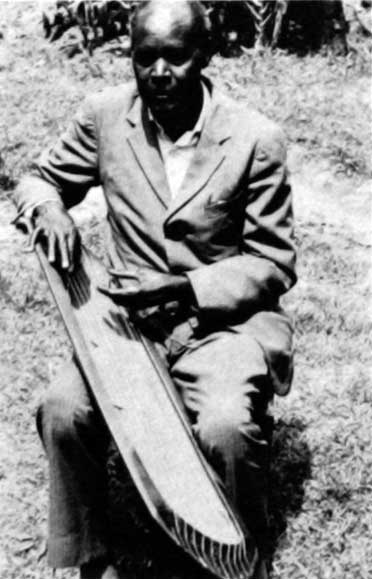
J. Sebatunzi playing the Inanga Zither.

Ikembe Lamellophon

Audience In Rwandan Hills

Amakondera Horn Orchestra


Umuduli Musicbow


Straight Shepherd Flute
Ingoma Drummers


Iningidi Fiddler

Insengo Ensemble From Nkumba


Music ▼ +