Showing posts with label khyal. Show all posts

Friday, June 17, 2011

An Anthology of North Indian Classical Music • Vocal Music


An Anthology of North Indian Classical Music Vol.I 
Vocal Music, Alap, Dhamar, Khyal, Thumri
Recordings and photography Manfred Junius
Commentary Alain Danielou
Bärenreiter - BM 30 SL 2051 - P.1975


Side A


Zahiruddin and Faiyazuddin Dagar
(Junior Dagar Brothers)


A1 Âlâp - Raag Ahir Bhairava 15'01
A2 Dhamar - Raag Ahir Bhairava - Dhamar 14'41


A2 + Gopal Das, Pakhawaj

Side B


Yunus Hussain Khan, vcl - Sabri Khan, sarangi
B1 Khyal - Raag Sujani Malhar - Ektal - Tintal 16'06


Dipali Nag, vocal - Sabri Khan, sarangi
B2 Thumri - Raag Bhairavi - Dipchandi tal 11'20


B1+2 Zamir Ahmad Kahn, tabla


Music ▼ +


Tuesday, June 14, 2011

Senior Dagar Brothers • Kamboji - Philips Unesco P.1971


Mohinuddin Dagar,  Aminuddin Dagar
Dhrupad and Khyal - North India, Vocal Music VI-2
Musical Sources - Modal Music and Improvisation
Philips Unesco -  6586 003  - P.1971


Side A

A1 Dhrupad - Raga Kamboji 29'47


Mohinuddin and Aminuddin Dagar, vocal
Raja Chhatrapati Singh, pakhawaj
Suraya Dagar, tanpura


Side B


B1 Khyal - Raga Malkosh 22'58


Robin Kumar Chatterjee, vocal
Nazir Ahmad, sarangi
Kedarnath Batt, tabla
P.S. Rajvedi, tanpura


Raga painting 18th century

Drumplayer 11th century, Deogarh


Northern Indian music represents the most characteristic form of purely modal music which is constructed in relation to an absolutely fixed base, the tonic (Sa), without any modulation or change of tonality during the development. In relation to this fundamental sound a scale is established which contains very precise and highly differentiated intervals; these intervals can differ slightly in each mode (raga), and correspond to distinct sentiments. Slight modifications of the intervals, for example a minor third which is raised or lowered by one comma, are felt as conveying very different sentiments. When making his way along the degrees of a mode, the musician brings out and emphasises their expressive qualities by means of ornaments, various ways of attacking the notes, and stylistic procedures. Such a development is only possible in improvisation, in the pursuit of an inner musical idea. A fixed melody allows only the existence of an outline of the sound-material; improvisation alone provides the means of shaping and differentiating it, of imbuing it with an infinite variety of forms. Therefore the only melodic elements proper, and the only ones which can be notated, are short motifs which serve to introduce the words of sung poems.

Once the musician has become aware of the mode and the theme, he sets out to develop and express them in a variety of ways in the successive styles which form the vocal discourse, the latter being composed of a very slow exposition, the Alap, followed by variations in quicker tempi. The words of the song are not taken up until the second part of the development. At the beginning, the voice is employed like an instrument. Indian music is fundamentally vocal, and all the instrumental techniques are conceived as an accompaniment to, or an imitation of vocal sonorities. Numerous and varied forms of song exist, the most important of which in the classical music are the Dhrupad, the oldest, the noblest, and the most austere form, and the Khyal, a form created in the fifteenth century which is more imaginative, more brilliant, and more whimsical (khyal). In each form the development proceeds according to successive formulas which are controlled by very strict rules in such a way that the performance of a piece, although improvised and always shaped anew in every detail, nevertheless unfolds in conformity with an overall design which is always identical.

Mohinuddin Dagar (1920-1967) and his brother Aminuddin Dagar (born in 1924) are regarded as the greatest masters of the Dhrupad, a genre which nowadays has hardly any more qualified representatives. They belong to a dynasty of musicians which represent a "musical tradition" (gharana), the origin of which goes back to Tansen, the celebrated musician at the court of the Emperor Akbar (1542-1605).


Robin Kumar Chatterjee (born in Bengal in 1942) is one of the most remarkable singers of the young generation, and one of the very few who maintain the pure tradition of Indian classical singing. He studied music with some of the greatest masters, in particular with Amir Khan who represents the tradition known as Kirana.

notes by Alain Daniélou 
snipped from the record sleeve

Side 1:


Alap and Dhrupad sung by Mohinuddin and Aminuddin Dagar; accompaniment: Pakhavaj (horizontal double-headed drum), Raja Chhatrapati Singh; Tanpura (lute giving the tonic, fifth, and octave), Mrs. Suraya Dagar.

The raga (mode) is Kamboji (diatonic with minor seventh), a mode which is sung at nightfall and expresses calm tenderness and sweet memories.

The tala (rhythm) is Chautala with 12 beats grouped in 4, 4, 2, 2.

The Alap, or extended prelude, is a wordless exposition of the sentiment of the mode. Conventional meaningless syllables are used to support the vocal line.

The Dhrupad (sung poem) proper begins with the entry of the rhythm provided by the drum. The words, which are many times repeated, are taken from an old poem in Hindi by Rasa Khan (Manusha ho to vohi...), which is an appeal to the shepherd-god Krishna: "I cannot live far from thee; cause me to be reborn as one of the cowherds or among the herds of the village of thy childhood."

Side 2:

Alap and Khyal sung by Robin Kumar Chatterjee, accompanied on the sarangi (bowed instrument) by Nazir Ahmad, on the tabla (pair of vertical drums) by Kedarnath Bhatt, and on the tanpura by P. S. Rajvedi.

The raga is Malkosh, a pentatonic mode without second or fifth arid with minor sixth and minor seventh. Malkosh is sung during the first pan of the night. It is a mode which expresses
peace, softness, and tenderness.

The tala is Eka tala with 12 beats grouped in 4, 4, 2, 2 in the first part (Bara Khyal), and Tintala with 8 beats grouped in 2, 4, 2 in the second part (Chhota Khyal).

The words, in Hindi, of the first part signify "he whom I love has come to my door..." (sajana aye mere dware...), and those of the second part "what strange unrest dost thou inspire in me. . ." (kaisi lagana lagai Balama).

In the Khyal the words are employed right from the beginning, but interludes on sol-fa syllables (Sa, Ga, Ma, Dha, Ni, Sa) also occur.


Recordings: Alain Daniélou (side 1) rec. 1965 
and Manfred Junius (side 2) rec. 1971


Phakawaj


tablas
tambura


Music ▼ +

Sunday, June 12, 2011

Ustad Nisar Hussain Khan - Raga Chhayanat, Desi Todi, Bhairabi


Ustad Nisar Hussain Khan 
• Raga Chhayanat, Desi Todi, Bhairabi
HMV EMI India - EASD 1427 - P.1984


Side A


A1 Raga Chhayanat - Sagari Ram-Kirpa, Jhanana Jhanana Jhananana Baaje Bichhua 25'48 


Raga Chhayanat - Sagari Ram-Kirpa - Khayal - Vilambat - Ektaal
Raga Chhayanat - Jhanana Jhanana Jhananana Baaje Bichhua - Khayal - Drut - Teentaal 


Side B

B1 Raga Desi Todi - Sanchi Kahat Hal Adha-Rang Ye - Khayal - Teentaal 14'50
B2 Raga Bhairabi - Tarana - Teentaal 10'24


Accompaniment: 
Harmonium - Ghulam Baqar Khan
Tabla - Anando Gopal Bandopadhyay
Tanpura: Ghtjlam Akbar Khan Zulfakar Husain Khan


Ustad Nisar Hussain Khan has throughout been acclaimed as one of the greatest exponents of North Indian Classical Vocal music and today he is indeed the foremost amongst the performing Ustads in the country. He hails from Rampur district which at one time was known to be the blessed abode of classical music and musicians' in North India.

With initial training received from his grandfather Ustad Hyder Khan, Ustad Nisar Hussain Khan was subsequently groomed and nurtured by his illustrious father Ustad Fida Hussain. In the early thirties Ustad Nisar Hussain Khan emerged as an outstanding Khayal and Tarana singer when a galaxy of stalwarts like Ustad Alladiya Khan, Ustad Wahid Khan, Ustad Rajah Ali Khan, Pandit Omkarnath Thakur, Ustad Fayaz Khan, Ustad Abdul Karim Khan, Smt. Kesarbai Kerkar and others had been adorning the scene of Indian Classical music.

The rulers of Indian States had till then been continuing with their patronage for nourishment and propagation of classical music. Sir Siyajirao. Gaekwad of Baroda, was greatly impressed by the remarkable artistry of Ustad Nisar Hussain Khan and the Ustad flourished as Court Musician of Baroda for long thirty years.

Ustad Nisar Hussain Khan has developed a distinctive style of his own which savours of a synthesis between two prominent schools of Khayal singing - Sahaswan and Rampur. His unique voice is sonorous and assertive. With innovative phrases and colourful patterns. Khan Saheb renders Khayal like a great architect. He expounds Ragas in a very systematic way and his Taans gliding reposefully through octave after octave are not only accurate but crystalclear as well. His Bol-taans in Tarana are his speciality and the excellence of his virile but polished style of presentation has earned him a very prestigious position in the realm of Hindusthani Classical music.

Listening to Ustad Nisar Hussain Khan is always an experience and a present-day connoisseur might wonder how the performing art of the Old Master could develop so much dynamically keeping pace with the stride of time. The septuagenarian tistad has kept himself alive to the modern trends and his expositions always reflect his progressive outlook and a freshness of creativity.

Ustad Nisar Hussain Khan has been the recipient of many honours and Tamra Patra awards. In 1970 he was awarded Pad ma Bhushan'. He received Fellowship of Sangeet Natak Academy in 1971. Uttarpradesh Natak Academy felicited him with Award and Fellowship in 1972. He was titled as Sangeet Mahamahopadhaya by the Hyderabad Gandharva Mahavidyalaya in 1968. Khan Saheb headed India's Goodwill Mission to Nepal and Afganisthan in 1975. He visited London in 1976 on invitation to perform in an International Conference.

In this album Ustad Nisar Hussain Khan has presented Raga Chhayanat on the first side. The Vilambat Khayal is in Ektaal and the Dna is in Teentaal. The Raga unfolded in a traditional manner, has been elaborated in all its facets with highly imaginative phrases and utter precision. The Taans are lively and amazing.

On the second side Khan Saheb has first rendered a Khayal in Desi Todi set to Teentaal. The sentiment of the Morning melody has been brought out with emotional fervour and keen sense of aesthetics. The Ustad has concluded his recital with a Tarana in Bhairavi and the composition is in Teentaal. The intricate rhythmic patterns and Bol-taons executed in his typical style are not only attractive but give clear glimpses of Khan Saheb's incomparable virtuosity.

Sarengee accompaniment provided by the veteran Ghulam Baqar Khan and Tabla by the young talent Anando Gopal Bandopadhyay are additional attractions of this album.


Music ▼ +

Nazakat Ali & Salamat Ali • Classical Music from Pakistan


Ustad Nazakat Ali Khan 
Ustad Salamat Ali Khan 
• Classical Music from Pakistan — Durbari, Kalavati
The Gramophone Company of Pakistan - CLP 1308 - P.1958 - 60?*


Side A


A1 Raag Durbari - 22'01
- Bhilampat - Jhumra Tal
- Durat - Tintal


Side B


B1 Raag Kalavati - 22'13
- Bhilampat - Tilwara Tal
- Durat - Tintal


Ustad Salamat Ali Khan (Born in 1934 in the Hoshiarpur district of Punjab, died in 2001), father of an entire family of vocalist-musicians, performed (at the age of nine), with his brother Nazakat Ali Khan, as the famed 'Ali Brothers'. They were internationally renowned as superstars in the 60's and 70's for their immense talent and artistry in the classical form.


Ustad Nazakat Ali Khan (1932? Older brother that died much earlier than Salamat)
(Most likely Tawfiq or someone else can fill in the dates here or I'll do it when I find them!)

Nazakat Ali - Salamat Ali

These two young artists, aged 26 years and 24* years respectively are well-known in the sub-Continent of Indo-Pakistan. They were taught by their father. Ustad Vilayat Ali Khan, a great exponent of classical singing, under whose able guidance they have attained for themselves a unique position among the exponents of classical music.

These two artists are followers of Sham Chroasi School of Music which has been in the limelight for many centuries, specialising in the faithful reproduction of the original form of each Raga (composition). Both, however, in adhering to the basic teaching have enriched their singing with new ideas giving a contemporary touch to their art.

The singing is accompanied by Tabla and a Sarangi. Tabla, played here by Ustad Allah Dutta, are a pair of drums — one treble, the other, bass. Sarangi played by Ustad Zahoori Khan, is a three-stringed instrument similar to a violin.

One of the most popular forms of classical music sung to-day is called “Khyal” which has two distinctive parts — the Bilampat (slow) and the Durat (fast). The invocation always starts in bilampat and gradually increases in tempo to end in Durat. Most classical singers are either able to sing well in Bilampat or in Durat but both Nazakat Ali and Salamat Ali are equally proficient in both, which is a great achievement, In this recording, Nazakat Ali and Salamat Ali treat you to two Ragas.

Side One : Raga Durbari

Raga Durbari is a composition of Tansen, the famous musician of Moghul Emperor, Akbar the Great, In this piece, which describes the Emperor's Court and all its pageantry, the young artists play Bilampat in 14 beats and Durat in 16. The mind and soul seem to be carried away into an atmosphere of purity and godliness.

The composition is as follows:


Do Rey me FA so LA See
Do See So me FA Ray Do


Side Two: Raga Kalavati

This piece was evolved recently by Maharashtrians and consists only of five notes. It expresses the loneliness and despair of a parted lover for this sweetheart. This is a rather sad and sophisticated piece and to be able to sing it well, the artist must first get into almost a trance as if he himself was the lover and it was he who was missing his sweetheart.

This Raga is made up of the following scale:


Do me So LA See
Do See LA So me Do

snipped from the backside of the record sleeve


* About the publishing date and birthdays please do your own math! I am lousy even at common addition!


Music ▼ +

Tuesday, June 7, 2011

Rasiklal Andharia • Marwa, Darbari Kanada 1985


Rasiklal Andharia 
• Marwa, Darbari Kanada 
EMI India - ECSD 2991 - P.1985


Side A

Raga Marwa [21'05]
- Piya More Anat Des - Khyal Vilambit - Jhoomra Taal
- Aeri Ae Maan Aawan Ke Sajan - Khayal Drut - Triltal


Side B

Raga Darbari Kanada  [23'04]
- Ae Mori Aali - Khyal Madhyalaya - Jhaptal
- Piya Ab Nahin Mane - Khyal Drut - Ektal


Shashikant Mulye, tablas

There will surely be many more posts on the Dagar family a few more are waiting in line but lets have something else for a change. Here is a singer I enjoy very much. Unfortunately like so often there is very little to find in ways of recordings. This is the only vinyl I know of and it is another find from one of the excursions in the murky recesses of the back room of the Panchamkauns editorial office. This and a also a CD titled Nirmal, and some clips on youtube are all I have heard.  if there are some more that you know of maybe you could tell me in the comments where to look and for what!

It is very hard to even turn up any information about him on the web so you are more than welcome to help! Apart from the recurring statement on various sites "info needed" these two items below are the only ones I have come up with and unfortunately this time there is virtually nothing to be learned from the record sleeve!

Rasiklal Govindji Andharia,  (b. 13.10.1931-) from Bhavanagar, Gujarat of the Kirana gharana, had his musical training from his father Babulal Andharia. Rasiklalji started his concerts at the age of 16 and captured many musiclovers hearts with his mellifluos voice.
(I am sure panchamkauns will love the "no frills, yet captivating wording here!)

Andharia, Rasiklal Govindji, b. 13.10.1931, 
M.Mus. Vocalist: Hindustani, khayal of Kirana Gharana.
Studied with Babulal G. Andharia.
Address: "Prerana,"
Plot No. 551-B, Sir Pattani Road,
Bhavanagar (Gujarat)


From "Who's Who of Indian Musicians" - 2nd edition (1984)


Fortunately my good friend Arvind, who has better skills and more patience sifting through the webs of the net, found this information for us!

The late Pt. Rasiklal Andharia came of a music-loving family from Gujarat. He was actively encouraged by his father in his musical pursuit. It was, however, his elder brother, Pandit Babulal Andharia, a scholar-musician, who gave the initial lessons in Classical Music. Thus Rasiklalji, in the manner of a true artiste gifted with talent and genius, forged ahead on his own. In this sense he can well be regarded as a self-taught musician. Even so, Rasiklalji's music bore the clear impress of the gayaki of the late Ustad Amir Khan. This is reflected in the way he could blend a plenitude of melodic and rhythmic virtues in his singing. What is more, his rich, sonorous voice had an uncanny emotional depth and enduring appeal - all of which often reminded the listener of the great Ustad.

The above is from this HMV Cassette of his music:

HMV/RPG STC 850312 
AIR Recordings 
Recorded 20/10/1974 

Shripad Nageshkar (tabla) 
Vasanti Mhapsekar (harmonium) 

Thank you very much Arvind!


Music ▼ +

Tuesday, May 24, 2011

Amanat & Fateh Ali Khan • Raag Darbari & Sakh - 1970


Amanat Ali Khan & Fateh Ali Khan 
• Raag Darbari & Sakh 
EMI Pakistan - ALPC 12 - P. 1970


Side A 

A1 Darbari 22’09

One of the most popular of our Raags Darbari was created by Naik Mian Tansen, one of the nine ‘gems’ of the great Moghal King, Akbar. It was the monarch himself, who in view of this Raag's stately form, inbuilt grandeur and majestic overtones gave it the name Darbari, literally meaning ‘of the court’ – that is a Raag fit for the Kings. This assessment of Darbari has not changed in the last four hundred and fifty years and it is still considered a Prince among the Raags. In fact no classical singer or instrumentalist can be considered to have finished his education without complete mastery over this important melodymode.

Amanat Ali Khan, Fateh Ali Khan's rendering of Darbari is in three phases. The opening slow movement is in Iktala a rhythm of 12 beats, the second in Teen Tal having 16 beats and the third even faster movement is a Tarana, also in Teen Tal.


Side B  

B1 Sakh 28’34

It is a seven note Raag of the family of Sakhs. The fourth and the seventh are flat and the rest of the notes are sharp. Structually and even emotionally it is close to Ragesri. The little changes of stress in the notes in the three composition bear testimony to their different origins. The spirit of the Raag. as indeed its treatment, gives the impression of peace, of quiet beauty and of subdued richness with the soft under current of gentle romance.

Sakh is sung for you in three movements. The first slow phase is in Iktala, the second faster movement is in Jhaptal – a rhythm of 10 beats - and the final movement, the Tarana is sung in Teen Tal.


The Sarangi accompaniment is provided by Ustad Hamid Husain
and the Tabla is played by Vajid Husain.


Here is a response to a very recent request. I was holding this back as I always think I could come up with some reason connecting one post with another but there is really no excuse not to post this. It was one of the records I brought with me to Peking in the seventies as a part of the life supporting music kit. Half of my suitcase contained music, free jazz, second vienna school, african field recordings and popular, arabic and indian classical and because of the times Peking opera was barely to be heard no recordings were available on kunqu opera so I brought a lot of that, and a lot of coffee and almost no clothes! This one got much playtime in my "student room turned musical café". Hope you enjoy. Truly music "of the court", the best thing with that is that in Luobaniya we can all be the pashas, the moghuls, the maharajas, the viziers, the caliphs, the nawab, the pradhans, diwans, and the sultans and the khans and... (did I forget someone?)... Anyhow true nobility exists only for those with ears to hear!


Amanat Ali Khan - b. 1932 — d. 1974


Fateh Ali Khan b. 1935


Amanat Ali Khan,  Fateh Ali Khan, receipients of Pakistan's highest music award, Pride of Performance (1969), are the grandsons of late Ustad Ali Bukhsh of Patiala.

Ustad Ali Buksh, in keeping with the ancient Dhurpud tradition, used to sing with his friend Ustad Fateh Ali Khan, father of late Ustad Ashiq Ali Khan of Patiala. He also had many memorable solo performances to his credit. So great was the fame of these two maestros, that to this day, nearly half a century later they are household names throughout the length and breadth of the sub-continent.

They had the good fortune of imbibing the knowledge from no less than four schools of Khayal singers. Their relentless devotion, combined with intrinsic talent and authentic musical education, flowered into a distinct form of Khayal singing, known as the Patiala Style.

The Patiala music is singularly rich in Khayal and Tarana compositions and has the freshness and vigour of the modern times along with the classical authenticity of the ancient Raags.

Today, Amanat Ali Khan and Fateh Ali Khan, sons of Ustad Akhtar Hussain Khan, represent the best traditions of the Patiala Style of Khayal singing. In this album you will hear their versions of Raag Darbari and Raag Sakh.

quoted from the sleevenotes of Salim Gilani


Monday, January 24, 2011

Bhimsen Joshi - Sangeet Amrit - Sur Malhar, Marwa Shri, Marwa


Bhimsen Joshi - Sangeet Amrit
- Sur Malhar, Marwa Shri, Marwa
EMI India - ECSD-2879 P.1981


Side 1

Raga Sur Malhar
- Garjat Aaye - Khayal Vilambit - ektaal
- Badarwa barsan lage - Khyal Drut - tritaal


Side 2

Raga Marwa Shri
- Sab jagat ke guniyan ko sukh deejo daata - Khyal Vilambit - ektaal
Raga Marwa - Tarana - tritaal


Friday, December 31, 2010

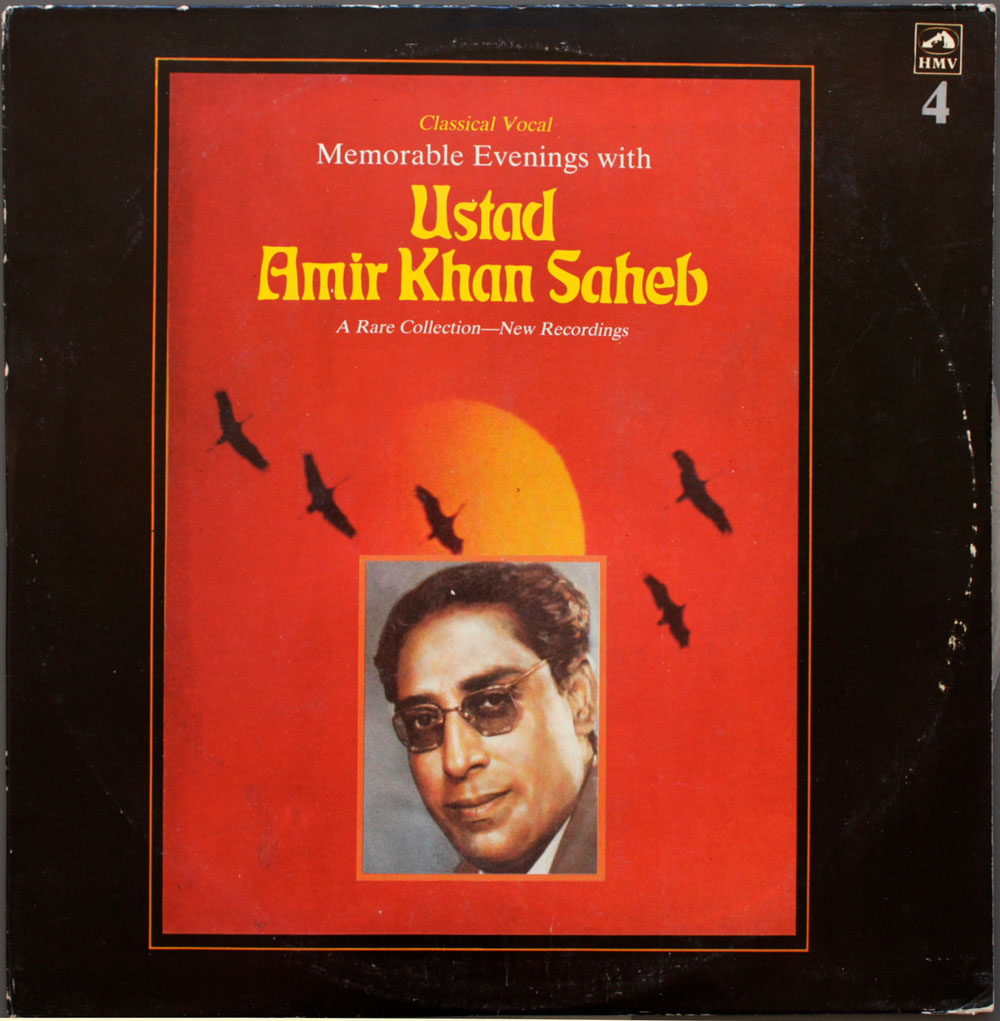
Ustad Amir Khan - Memorable Evenings, Volume 4


Ustad Amir Khan - Memorable Evenings, Vol. 4
- Jog, Darbari Kanada
EMI-His Masters Voice - PMLP 3062 - P.1989


Side A

A1 (a) Jog: Khayal in vilambit roopak taal "O balma" /
A1 (b) Khayal in drut teentaal "Saajan more ghar aye" (28.25)

Side B

B1 a) Darbari Kanada: Khayal in vilambit jhaptaal "Mori aali ri jab se bhanak" /
B1 b) Khayal in drut teentaal "Kin bairan kaan bhare" (28.37)


Ustad Amir Khan - Memorable Evenings, Volume 2


Ustad Amir Khan - Memorable Evenings, Vol. 2
- Shuddha Kalyan, Bageshri
EMI-His Masters Voice - PMLP 3060 - P.1989


Side A

A1 Shuddha Kalyan: Khayal in vilambit jhoomra taal
"Karam Karo" / Tarana in drut teentaal (29.53)

Side B

B1 Bageshri: Khayal in vilambit jhoomra taal
"Begun kaamna jaage" (29.29)