Tuesday, May 25, 2010

K.L. Saigal - The Immortal Saigal


K.L. Saigal - The Immortal Saigal - Mere sapno ke rani and other Songs
Hindusthan Records LP-1418-0002 P.1977


Side One

01 Mahabat Sey Kavi (Parwana)
02 Milan Ko Din (Tadbir)
03 Hum Apna Unhey (Banwara)
04 Mahabat Ke Gul (Kurukshetra)
05 Merey Sapno Ke Rani (Sahajan)
06 Muskuratey Huey (Banwara)

Side Two

07 Oos Mast Nazar Pey (Parwana)
08 Kidhar Ho Tu (Kurukshetra)
09 Mai Kismat Ka (Tadbir)
10 Diya Jisney Dil (Banwara)
11 Janam Janam Ka (Tadbir)
12 Kaya Hamney Bigara (Banwara)


So, when it comes to Indian filmi and old plates. Here is the real object of my undivided musical love and nostalgia for almost forty years now. There is so much music, especially from India that I will share with you here but I cannot any longer keep him from you, and hopefully I can turn some of you on to this absolutely delightful pleasure. There is nothing more foolproof than being nostalgic for locations one had no chance of being in, at times one have not lived through. At least not when they were happening! But who is concerned with such trivial details, and anyhow, not even the future is what it used to be!
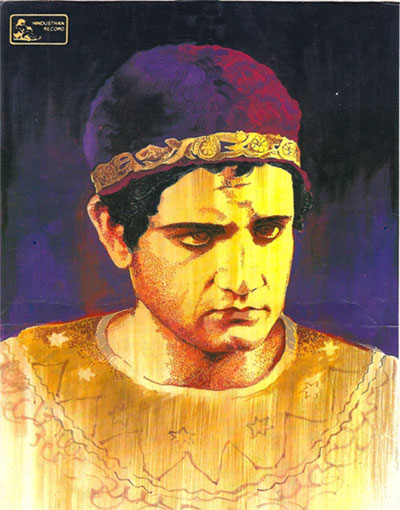

Kundan Lal (K.L.) Saigal (April 11, 1904 – January 18, 1947)

This is one of my big "singing heroes". I am a bit nutty about anything by Saigal. Especially the sentimental tunes and fortunately most of them are ...

As far as I have been able to find out there is only one biography over Saigal in english and it has long been out of print.


But here is another, altho brief account, to get a little background.


The Legendary K. L. Saigal


By: Farhana

Eons have gone by since his voice left people awestruck. K. L. Saigal was really the first male superstar of Indian Cinema who set the tone for musical melodrama acting in the 1930s and 40s. He was the pioneering singer of Hindi films. In the span of 15 years, he acted in 36 films and sang over 200 songs.

The virtuoso of music appraises Saigal as the 'Ghazal King'. Recognized as the greatest singer of the century, K. L. Saigal was a musical genius who mesmerized his audiences with his powerful and mystical rhythm, which had a touch of the divine. Without any formal training, Saigal stunned the music maestros of his time with his intuitive discernment of the (note/tune) 'ragas' and his splendid and reverberant voice.

Kundan Lal Saigal was born at Jammu on 12th April 1904. At the age of twelve Saigal gave a rendition of Meera Bhajan in Pratap Singh's court. The Maharaja was impressed and predicted that Saigal had a bright singing future. He was introduced to music by his mother. His only formal training apparently came from a little known Sufi peer, Salman Yussuf.


In 1932 K.L. Saigal's film career launched when he signed a contract with New Theatre to act and sing in films. Though not conventionally good-looking, people responded to his every man demeanor, that voice and his dialogue.

Saigal's first film was Mohabbat ke Aansoo (1932) but it was with the success of Chandidas (1934) that he became a star. Bhakt Surdas (1942) and Tansen (1943) were big hits and consolidated his popularity. The songs of Tansen are brilliant in their royal glory. The film successfully shapes the classical and semi-classical thumris and dadras to the need of cinema. Above all, the film is still remembered for Saigal's astonishing rendering of Diya Jalao in raag Deepak. Meri Bahen (1944) is technically one of Saigal's best films at New Theatres and was known of course for its music. As an actor-singer, Saigal attained unprecedented fame and popularity.

In 1935 Devdas benchmarked the star-singer's popularity. The story of a love-struck and doomed Devdas, based on Bengali writer Sharatchandra Chaterjee's novel and directed by P.C. Barua, the film was a triumph for Saigal and took him to dizzying heights. Saigal brought alive the character of Devdas creating the archetype of the relentlessly luckless, tragic hero. His brooding looks, the vagrant lock of hair, the sonorous voice filled with love and despair drove the nation into frenzy.

Saigal the singer surpassed Saigal the actor. The singing tradition he assimilated emphasized the poetic blending of syllables into musical forms. Saigal loved Urdu poetry. His musical interpretation of the ghazal gave a new form and content to the meaning of the verse. He produced an amazing array of emotions and sentiments. In fact, he succeeded in striking similar chords in the listeners' hearts. Many Urdu poets like Zauk, Seemab, Bedam, Arzu and Hasarat became famous, thanks to Saigal's translation of their poetry.

But Saigal's most favorite remained the great Mirza Ghalib. He immortalised Ghalib by singing his verses with his heart and soul, interpreting the deep meaning of every syllable. It is through Saigal that Ghalib gained vast popularity even among audiences who were foreign to Urdu. His renditions of Mirza Ghalib's poetry and his identification with its tragic iconography formed the famous Saigal persona. It is a less known fact that Saigal himself was a poet and is said to have recited his own compositions.

He brought music to the masses and, with his unique style, gave a totally new dimension to the music of his time. Up till 1946 right from 1932 the Hindi film world was called as K. L. Saigal musical era. Saigal had taken to alcohol and hence his health began failing. Saigal breathed his last on 18th January 1947 in Jalender, his hometown. The legend passed away depriving music lovers of his celestial voice. Sixty years since his demise, the immortal singer's haunting resonant voice continues to enchant listeners on early morning radio or on some fanatic collector's old gramophone player.


Another label from one of the numerous 78 rpm's.


Himself of plain background was always the elegant mild mannered gentleman.
He brought brilliant love poetry and refined music to the masses


Here is what another, anonymous snippet, has to tell:


Songs of K. L. Saigal

Famous Hindi Cinema actor and playback singer K. L. Saigal was born on April 11th, 1904 at Jammu, Jammu and Kashmir. Apart from his playback singing, he was also an actor and is considered the first superstar of Bollywood. He was born to the family of Amar Chand and Kesar Bai. His father was a tehsildar at the court of the Raja of Jammu & Kashmir and his mother was a deeply religious lady who was very fond of music. He was fourth of five children in the family and his formal schooling was brief and uneventful. His mother used to bring him in religious functions where ‘Bhajans’ and ‘Kirtan’ and ‘Shabad‘ were very commonly sung. Those bhajans or krtans were based on classical music which later inspired him. Later he was dropped out of school and he started working as a railway timekeeper. He married Asha Rani in 1935 and had three children.

Later he joined the Remington Typewriter Company and worked as a typewriter salesman. His work allowed him to tour several parts of India and once he moved to Lahore where he met with Meharchand Jain. Later both moved to Calcutta and had many a mehfil-e-mushaira. By that time Saigal was a budding singer and got the appreciation from his friend Meharchand. His passion for singing continued and became more intense with the passage of time. Then he was hired in 1930s by B.N. Sircar who was the head of the Calcutta-based film studio named New Theatres. Here Saigal met with some respected music composer and his contemporaries like Pankaj Mullick, K. C. Dey and Pahari Sanyal. He was employed by New Theatres on a contract basis of rupees two hundred per month. In 1932, K. L. Saigal made his debut in the Hindi Cinema with the movie titled ‘Mohabbat Ke Ansoo’ which went unnoticed.

Later in the next year 1933, he gave his voice in the movie ‘Puran Bhagat’ where he sang four bhajans which created a sensation throughout India. He was shot to fame with those bhajans and he never looked back. Once, legendary Lata Mangeshkar is alleged to have said that she wanted to marry K.L. Saigal after seeing his performance in Chandidas. It was the year 1935 when he appeared in ‘Devdas‘ as a lead actor and also he had given his voice to the songs in the movie. His songs “Balam Aaye Baso Moray Man Mein” and “Dukh Ke Ab Din Beetat Naahi” created history in India. Some of his movies in which he acted as lead actor such as President (1937), Street Singer (1938) and Zindagi (1940) became famous for his singing. Saigal moved to Bombay in 1941 where he worked with Ranjit Movietone. His movie ‘Tansen‘ in 1943 was always be remembered for his song “Diya Jalao” and “Sapta Suran”. He died at the age of 42 at Jalandhar on January 18th, 1947.


Some Hit songs of K. L. Saigal :

1. Thukra Rahi Hai Duniya - Bhanwara
2. Jab Dil Hi Toot Gaya - Shahjehan
3. Diya Jalao - Tansen
4. Dukh Ke Ab Din Beetat Naahi - Devdas
5. Mere Sapnon Ki Rani - Shahjehan
6. Babul Mora Naihar - Street Singer
7. Avasar Beeto Jaaye - Puran Bhagat


Here is a clip from one of his movies. The song is "Mere sapnon ki rani"


Two compilation LP covers from the sixties of Saigal's songs.


Here are some more YouTube links to famous songs

these first few are some of my real favourites:


Kundan Lal Saigal died of cirrhosis of the liver on 18th January 1947.
The band played Jab dil hee toot gayaa at his funeral as per his dying wish.
Just around 250 soulful songs and 28 films had made K.L. Saigal immortal in the Musical Hall of Fame.


This LP was presented to me by a friend in music and I thank him much for that!


Sunday, May 23, 2010

Greatest Hits of Pankaj Mullick - rec. 1935-47


Pankaj Mullick - The Greatest Hits of Pankaj Mullick
Angel - EMI - EAHA.1003 - P.1962


Tracks:


A1 Aaj Apni Mehnaton Ka
A2 Aai Bahar aaj *
A3 Piya milan ko jana
A4 Sharabi soch na kar
A5 Yeh koun aaj aya
A6 Madbhari Rut Jawani

B1 Yeh raaten yeh mousam
B2 Pran chahe naina na chahe
B3 Tere mandir ka hun
B4 Jab chand mera nikla
B5 Main ne aaj piya
B6 Main rota hun


* clip of this song on YouTube (rather skippy recording but you have the LP to listen to)


It seems only fair to start off with Pankaj Mullick both because he wrote so much material that it was enough for both him and K.L. Saigal and other artists as well. He was a very good singer and at the same time a very productive composer that wrote innumerable hits of the time. Unfortunately there has been no CD reissues devoted entirely to his singing. To my knowledge there is only one CD split with Saigal on Hindustan Records and a recent 2 CD release of his songs featuring him singing on some of the tracks. I have not listened carefully to those yet but I'll report back later. Of course he is represented with one or two tracks on innumerable compilations but mostly the same tracks. His compositions are all over the place sung by both contemporary and modern singers.


Pankaj Kumar Mullick 1904 - 1978


A Short Biography


Pankaj Kumar Mullick is one of the most notable singers from Bengal. He is very much known for his contribution towards Rabindra Sangeet. He has done music direction in many Bengali movies and received the “Best Music Director” award for his work in Bengali Film “Dui Purush”.

Pankaj Mullick was born on 20th April 1904 in Calcutta, India. Pankaj Mullick was son of Manimohan Mullick who had a great interest in traditional music, and would invite eminent singers and instrumentalists to perform during religious festivals. Born in a middle class Bengali family, it was here that Pankaj Mullick drew inspiration from classical Hindustani music. From a very early age, he decided that his vocation would be music, and though enrolled in college, he did not pursue higher education. After completing his college studies he became a student of Durgadas Banerjee. Later, he joined Dinendra Nath Tagore for learning music. His first record was released by the Videophone Company in the year 1926.

Pankaj Mullick was lucky to be introduced to the Tagore family, which was to have an everlasting influence upon him. Rabindra Sangeet became his forte, and he is the only man who has tuned a Rabindranath poem to music, 'Diner Seshey, Ghoomer Deshey' with the great poet's total approval. The approval of the great poet came to Pankaj after endless numbers of hours of waiting on him, and the story has it that it was for a college function that Pankaj had approached the great poet to have his permission to perform one of his poetries, to which Rabindranath Tagore asked him to sing out the composition that he had in mind. It was after hearing his composition that Rabindranath was so very overcome with the tune that he granted him a total approval for all his poetries. Thus was through Pankaj Mullick's songs that Rabindra Sangeet became popular in every Bengali household, even raising great interest among Western music connoisseurs.

Pankaj Mullick regarded the balance and equanimity of the mind as his best asset, providing him with status as a human being and an artiste. Pankaj Mullick enjoyed a very close relationship with AIR (All India Radio) since its very inception in 1928, then a private broadcasting organization. For very many years, his Sunday music lessons had thousands of listeners, specially among young girls. It was at his initiative that the use of the tabla was introduced to keep rhythm for Rabindra Sangeet, which the poet had not previously adopted.

Though not really an actor, even though appearing in some six or seven films, his first experience was in a small role in Chashar Meye. It is interesting to note that when this silent film was being exhibited at Calcutta, Pankaj Mullick would conduct his orchestra to provide background music. Pankaj Mullick and R. C. Boral supplemented each other on many occasions whilst composing music for New Theatres' films. One of the Pankaj Mullick's most notable scores was for Mukti in which director P.C. Barua had assigned him a role.

On joining the New Theatres in 1933, he composed music for 'Yahudi ki Ladki'. He assisted R. C. Boral in Dhoop Chaon (1935), Karorpati and Manzil (1936) and President (1937). His Bengali films include Mukti (1937), Desher Mati (1938), Badididi (1939), Jiban Maran (1939), Nartaki (1940), Daktar (1940), Meenakshi (1942), Dikshul (1943), Dui Purush (1945), Nurse Sisi (1947), Ramer Sumati (1947), Pratibad (1948), Roop Katha (1950), Nabin Yatra (1953), Mahaprasthaner Pathey (1953), Rajkamal (1955), Louha-Kapat (1957), Aahwan (1961) and Bighalita Karuna Jahabi Jamuna (1972).

Pankaj Mullick wrote many books, a few of them are : Geet Valmiki, Swara Lipika, Raga Lakshana Geet Manjari and Mahishasura Mardina. He received Dada Saheb Phalke Award in 1972. He died on 19th February 1978. The first person to reach his residence was R.C.Boral.

Some more YouTube clips from movies starring Pankaj Mullick.


The above is a quote from an article on him spread on several indian webpages. I am sorry, but I was not able to find the original first post. anyhow I think it is a good comprehensive outline of the man. I'll see if I can give a better reference for the quotation later.


Pankaj Mullick has been posted


Roots of Bollywood - The New Theatres Era - Filmi & Plates. [1930-1950]


Hindustan Records 78 rpm label


Filmi & Plates - Early Songs from India. [1930-1950]


Early Indian Movie songs - Roots of Bollywood
Saigal, Mullick & The New Theaters Ltd. era


I am introducing a long time passion here, namely Filmi Music, and since the beginning of the seventies, when I started collecting early film music from India, I borrowed, from a fellow student and poet from Bengal, my first LP's of Pankaj Mullick, Satchin Dev Burman and above all, Kundan Lal Saigal, I have never since stopped enjoying the wonderful soothing voices of them and their contemporaries. and have traced down a lot of those recordings. It is a great medicine and I always carry some with me for weary moments.


Calcutta in the 40's

"Filmi" is the indian common expression for songs from movies & "Plates" originally how 78 rpm shellac records were and is referred to in India.


Poster from the movie Tansen a big Saigal hit

"Early songs from India", well it includes music from stagedrama before and during the film era, and I wanted to be able to include songs that were popular but not neccesarily included in any movie or drama, but of similar genre, like light classical, contemporary popular lovesongs and comical songs and ditties.

[1930-1950] Choosing these years for he period may sound strange, and maybe extend a bit too late for my intention, but my hopes were of course not to immediately jump into modern or contemporary "Bollywood" movie songs, rather concentrate on the origins of the same! Even to the point of excluding the sixties and later, even including the fifties, much of what is considered the golden era, I felt I was stretching it a bit looking at what I really had in mind. I will begin with "The New Theatre's Era" including my absolute favourites Saigal & Mullick.
I will first supply a little background to the time by quoting an article about the Hindustani Records company, a very important National label at the time, later on succseeded by INRECO.


Early Indian Movie songs - Saigal, Mullick & The New Theaters Ltd. era


It is said that CC Saha or Chandi Charan had been introduced to Tagore in Heidelberg by Soumendranath Tagore, and the poet was among the 500 shareholders of Hindusthan Record.


Rabindranath Tagore

Chandi Charan visited Germany to buy recording equipment, and subsequently George Neumann from that country helped him trap the voices of great artistes on resin. The company had the distinction of bringing a Neumann disc-cutting machine from Germany in 1932.
This piece of antiquity has since been donated to the Birla Industrial Museum. Hindusthan was the first to transfer from optical film to disc.
At the same time, CC Saha opened a well-stocked music shop at the crossing of Madan Street and Dharamtalla. Although it is dusty, it is still a mecca for lovers of Bengali music. It may sound surprising, but the shop still sells Bengali music from its golden era down to present times.
Hindusthan Musical Products Ltd, as it was officially called, can take credit for making the first recordings of classical music stalwarts such as Ustad Faiyaz Khan and Ustad Bade Ghulam Ali Khan, besides launching a star like Kundan Lal Saigal.

The first Indian-owned music company attracted a galaxy of artistes like Pankaj Mallik and Sachin Deb Burman. After BN Sircar set up his film production company named New Theatres in Calcutta, its songs were initially released under that label. From the 1940s onwards, the company extended its repertoire to include songs popular in the Hindi-speaking belt, and numerous recording were conducted in Bhojpuri, UP folk, Chhattisgarhi folk, qawwali, bhajans and aartis. It also made forays into Oriya, Nepali and Gorkhali song markets.


The original entrance to Hindustan Records

But the mainstay of Hindusthan Records remained Bengali songs and artistes like Debabrata Biswas, Subinoy Roy, Rajeshwari Datta, Shantideb Ghosh, Purna Das Baul and Asoketaru Bandopadhyay remain its bestsellers.

The successor of Hindusthan Musical Products was the Indian Record Manufacturing Company (Inreco) set up in 1977, the third record manufacturing unit in India that was Indian-owned.
Inreco started with a wide range of artistes from Punjabi to Bhojpuri to Marathi, Tamil and Malayalam. Lata Mangeshkar, Asha Bhosle, Pandit Mallikarjun Mansur, Kumar Gandharva, Ustad Amir Khan and Manna Dey were among the artistes it recorded.


read the whole article here:


A whole lot of reissues have appeared over the years mostly with songs by K.L. Saigal but one collection exists that is giving a first introduction to some of the early artists on this CD.

Bold

Uma Devi, Mullick, Pahari Sanyal, Asit Baran
Songs from New Theatres' Era
Hindusthan Record - IP 6008 - P.1994


More info can be found about most of the reissues on their webpages:

For those with access to Spotify™ you can listen online here:


There is NO download link on this page, but the following posts will contain links to some LP's of reissued 78 rpm material that to listen to by some of the artists mentioned in this post.


Wednesday, May 19, 2010

The Peuls - Musical Atlas vol.14 - Unesco Collection


The Peuls - Musical Atlas vol. 14 - Unesco Collection
EMI Italiana 3 C 064-18121 - P.1975

Side A

A1 Praise song, Flute Solo
A2 Praise Song, Stringed Lute
A3 Praise Song, Reed Pipe
A4 a) Jew's-Harp without frame *
A4 b) Jew's-Harp without frame *
A4 c) Rhythmic Song, Handclapping *
A4 d) Jew's-Harp without frame *
A5 In the Arabian style
A6 Song accompanied on the Flute and the Calabash


Side B

B1 Flagellation Song, Solo voice
B2 Song accompanied on the Flute and Calabash
B3 Solo Voice and Womens Choir
B4 Solo Voice accompanied by three young Women
B5 Pounding Millet
B6 Instrumental Music for Dancing
B7 Four Flagellation Songs
B8 Song for Dancing


* Note well, that track 4 a,b,c,d are one track on the LP, I split them for clarity as track 4c is not Jew's-Harp, as listed on the LP, but rather could be described as rhythmic song and handclapping.


This is an LP from EMI Odeon Italia in their series World Atlas. It was part of the Unesco Collection supervised by the General Editor Alain Danielou. The recordings and documentation was done by Simha Arom. They published maybe around 30 LP's in this series. I have only knowledge of the titles for most of them and I will post a few more. Maybe someone can help out with more information. I have been thinking of maintaining discographies online edited by several participators but more on that later.


The Peuls

The Peuls, (or Fulani) are spread across Senegal, Niger, North Cameroon, North Nigeria usually defined as a group by the common feature of being nomadic herdsmen and does not form an ethnic group or a race. They are also spread in Guinea-Bissau, Mauritania, Central African Republic, Mali, Gambia, Liberia, Ghana and Sierra Leone. And the estimated total figure of the population at the time of recording in the early 1970ies was believed to be in excess of six million people. Since they are so spread out it is hard to get a updated figure but it is believed that the population have more or less doubled today. These recordings, judging from the liner notes, seems to have been made in Niger and possibly Burkina Faso then Upper Volta and also belong to that category of records where closeness and intensity is pulling the lister into the group of musicians. I especially like the women pounding millet and the non compromising and relentless suction of air in the frameless Jew's Harp pieces. It seems also that we tend to do all too little rhythmical clapping around where I reside.


Tuesday, May 18, 2010

Musiques du Cambodge des forêts - anthologie de la musique des peuples


Musiques du Cambodge des forêts
anthologie de la musique des peuples - LP AMP 2902 P. 1970?

Side A

A1 Solo de guimbarde 2'50
A2 Chant d'homme et feuille vibrante 2'40
A3 Chants alternes et guimbarde 4'30
A4 Solo de feuille d'arbre 0'50
A5 Aerophone a anche libre et chant 3'05
A6 Chœur de deux hommes 4'00
A7 Solo d'areophone a anche libre 1'55
A8 Polyphonie de deux guimbardes 1'15

Side B

B1 Voix de la possesee Kuy 1'30
B2 Musique des divinites Kuy 4'30
B3 Invocation au protecteur du fer 1'55
B4 Chant de la recherche dans la foret 4'15
B5 Voix de la possedee Cham 2'30
B6 Orchestre du sacrifice du buffle 2'30


This is a real treat, and it seems that this rather hard to find LP unfortunately is the last I can post from this label, at least for a while. I thought I had one or two more but I am unable to locate those right now.

Anyhow, this LP, together with the Madagascar one, that I posted earlier, are my favourite of all the LP's on this label, and it makes me very happy to share this one as I am already certain of some of the reactions by some followers of this blog. It has lots of the "being there" feeling and it is full ov "organic instruments" like playing on leafs etc. Just like I like it! Hope you enjoy, and don't forget to tell me if you find other titles on this label.


Note that track B1 & B2 should be played gapless it is one track on the LP but listed
as two on the label and back of sleeve.


Achik Nesimi - Le chant des "troubadours" de Turquie - anthologie de la musique des peuples

Achik Nesimi - Le chant des "troubadours" de Turquie
anthologie de la musique des peuples - LP AMP 2908 - P. 1970?


Side A


A1 Bende Su Dünyaya Geldim Geleli - Depuis que je suis dans ce monde 4'40
A2 Acilin Kapilar - Les portes, ouvrez-vous 3'10
A3 Bir Güzel Bahcem Var Benim - J'ai un très jolie jardin 3'55
A4 Koca Tanri - Grand Dieu 4'57
A5 Asiklar Diyari - Au pays des troubadours 4'50


Side B

B1 Dur Diyorlar Bana - On me dit d'arrêter 6'03
B2 Cöplükte - Dans les poubelles 5'03
B3 Agla Gönlüm - Pleure mon cœur 9'45


Another good record fallen into oblivion. No CD reissues that I know of. Actually I have not found any other records by this singer published outside Turkey and the ones in Turkey seems to be long out of print as well. A biography of Asik Nesimi Çimen and all the lyrics are included in the bilingual (french and english) liner notes. All music is by Asik Nesimi, the A-side has lyrics by traditional poets and the B-side is his own poetry. A mild burning fire emanates from his gentle playing and glowing lyrics.


Sunday, May 16, 2010

Les Musiques d'Île de Paques - anthologie de la musique des peuples

Les Musiques d'Île de Paques - Rapa Noui
anthologie de la musique des peuples - LP AMP 2908 P. 1974?


Side A

A1 ka onga ira
A2 ka hia manou
A3 kaï kaï
A4 hanga rahi a akou
A5 i he Hotou Matoua
A6 hétaoua o taaou
A7 makoï naou opata
A8 Hérou Apatou
A9 Hiva kara réré

Side B

B1 ka vévéri ka ara (love dream)
B2 mahatou iti iti
B3 Anakéna
B4 ité mééna éki éra
B5 haka kio
B6 tomou téa
B7 Church Song, during the Sunday Mass at Honga Roa
B8 Canticle in honour of the Virgin of Rapa Noui


There is unfortunately very little music to be found from Easter Islands, I know only of one German CD (from the nineties, and most likely out of print).