Sunday, November 21, 2010

Bismillah Khan - The Soul of Shahnai


Bismillah Khan - The Soul of Shahnai
EMI India - ECSD-2833 - P.1979


Tracks

Side A

A1 Vignettes of Poorab Tradition - Kajri
A2 Vignettes of Poorab Tradition - Poorbi
A3 Vignettes of Poorab Tradition - Chaiti

Side B

B2 Melodies of Love - Raga Tilak Kamod - Jhaptaal
B1 Melodies of Love - Raga Jogiya - Tritaal


I promised before to post more Bismillah Khan! He is one of the musicians who more than many, over the years, since I first heard his mellifluous but never frivolous shenai in the sixties, that constantly have helped me in my life! The compassion and warmth that I feel emanating from his person and his breath through the reeds, have helped to clean both my ears and mind from the travails of this dusty world. To many listeners to the musics of this blog he needs no description, and the long artistic career beginning all the way back in the third decade of last century and spanning into the first of this one. Fortunately his recordings proliferated during the late sixties and early seventies as those recordings, to my ears are his prime ones. There certainly were many good recordings over the years to follow, although I think many of those had the Ustads shenai drowning by the sound of the "Party" and by poor mixing, where percussion was given too much prominence.

I will continue to post some more LP's of mostly indian pressings, and although almost all of them are still in mint condition, there is the occasional surface noise, some pops and other artifacts due to pressing technology of the times. I am not trying to filter or edit anything except pops and clicks between tracks. I may update some of the more valuable posts later if I get enough time to do any filtering and editing, but as it stands all my rips will be left as intact as possible! On occasion there is slightly more noise in the beginning of an LP-side but that often just goes away after a few seconds into the record.

The music is anyhow magnificent regardless and I hope you will enjoy this as much as I and his Excellency with whom I share my great admiration both for the person and the musician Ustad Bismillah Khan! And some more good news is that his Excellency has already committed some other items from his collection for me to share with you later on.


Ustad Bismillah Khan Sahib (Urdu: استاد بسم اللہ خان صاحب; March 21, 1916 ? August 21, 2006) was an Indian shehnai maestro. He was the third classical musician to be awarded the Bharat Ratna (in 2001), the highest civilian honour in India and gained worldwide acclaim for playing the shehnai for more than eight decades.

Bismillah Khan was perhaps single handedly responsible for making the shehnai a famous classical instrument. He brought the shehnai to the center stage of Indian music with his concert in the Calcutta All India Music Conference in 1937. He was credited with having almost monopoly over the instrument as he and the shehnai are almost synonyms.

Khan is one of the finest musicians in post-independent Indian Classical music and one of the best examples of Hindu-Muslim unity in India and had played shenai to audience across the world.He was known to be devoted to his art form that he referred to shehnai as his begum, wife in Urdu, after his wife died. On his death, as an honour, his shehnai was also buried along with him.He was known for his vision of spreading peace and love through music.

Khan had the rare honor of performing at Delhi's Red Fort on the eve of India's Independence in 1947. He also performed Raga Kafi from the Red Fort on the eve of India?s first Republic Day ceremony, on January 26, 1950. His recital had become a cultural part of India's Independence Day Celebrations, telecast on Doordarshan every year on August 15. After the Prime Minister's speech from Lal Qila (the Red Fort,) in Old Delhi, Doordarshan would broadcast a live performance by the shehnai maestro. This tradition dated from the days of Pandit Nehru.
[edited from the Wikipedia]

Wednesday, November 10, 2010

Premiere anthologie de la musique Malienne - Cordes Anciennes - 5


Premiere anthologie de la musique Malienne
- Cordes Anciennes - 5
Bärenreiter - Musicaphon - BM 30 L 2505 - P.1971


Side A


A1 Sunjata
A2 Julu Kara nayni
A3 Ala la Ke
A4 Duga
A5 Kayra
A6 Kulanjan

Side B

B1 Toutou
B2 Mamadou Bitiki
B3 Tara
B4 Asumka
B5 Ala la Ke


Batrou Sekou Koyate


Djelimadi Sissoko


Sidiki Diabate &
Djelimadi Sissoko


Sidiki Diabate


Premiere anthologie de la musique Malienne


Premiere anthologie de la musique Malienne
Editions du Ministere de l'Information -
Bärenreiter - Musicaphon


BM 30 L 2501 Le Mali des Steppes et des Savanes - 1
BM 30 L 2502 Le Mali du Fleuve - 2
BM 30 L 2503 Le Mali des Sables - 3
BM 30 L 2504 L'Ensemble Instrumental du Mali - 4
BM 30 L 2505 Cordes Anciennes - 5
BM 30 L 2506 Fanta Damba - 6


Those are the volumes published in the first series of Music from Mali on the German label Bärenreiter - Musicaphon.

This is just a preamble to announce the imminent arrival of most of the volumes in this series.
A good friend was in search for one of them a few days ago and that was the original incitement to follow up with the coming posts. So just let me caution you to the possibility that they will materialize here soon!

And finally they have! Now they are all here!

Just click on the catalogue numbers to go to the various posts!


Saturday, November 6, 2010

ESP 165506 Le Koto de Yusen Kuzuhara et le Shakuhachi de Teiji Itoh - Vol.3


Prestige de la musique extraeuropéenne - Le Japon - Vol. 3
Le Koto de Yusen Kuzuhara et le Shakuhachi de Teiji Itoh
Disques Espérance - ESP-165.506 P.1978


Face A

A1 Kumoi jishi
A2 Sho-chiku-bai
A3 Shika-no-tohne


Face B

B1 Miyako no haru


Kuzuhara Yuzen, Koto
Itoh Teiji, Shakuhachi


ESP 165505 - Le Koto de Yusen Kuzuhara - Vol.2 - P.1978


Prestige de la musique extraeuropéenne - Le Japon - Vol. 2
Le Koto de Yusen Kuzuhara
Disques Espêrance - ESP 165.505 - P.1978


Face A

A1 Chidori no kyoku
A2 Rokudan no shirabe

Face B

B1 Adikaze no kyoku
B2 Yachiyo jishi


This is my favourite of the three japanese records in this series , probably because of the singing. Yuzen Kuzuhara hailing from the Yamada school of koto, sings to her own accompaniment.


Le Koto de Hiromu Handa - Vol.1 - P.1977


Prestige de la musique extraeuropéenne - Le Japon - Vol. 1
Hiromu Handa - Le Koto de…
Disques Espêrance - ESP 155.551 - P.1977


Face A


1 Yumé-no-shinnaï, petite pièce à la manière de shinnai, musique pour shamisen


2 Itsugui-no-komori-uta, berceuse d'Itsugui, village de la région de Kumamoto au Kyûshû
3 Karéi-naru-shirabé, impromptu inspiré par la beauté des kimonos de cérémonie.
4 Sado-Okessa, chant populaire de l'île Sadogashima sur Okéssa, rythme spécifiquement japonais
5 Sandan-chô, piece en trois mouvements
6 Kyo-uta, mélodie avec des refrains nostalgiques

Face B

7 Sakura-kaété-godan, cinq variations sur l'air Sakura (fleur de cerisier)
8 Yoï-matsuri impression musicale au soir de la fête (matsuri) de l'enfence
9 Hônen-matsuri, compositions sur la fête de la moisson. Thème et développements
10 Midaré, œuvre classique composée par Kurabashi-Kengo (mort en 1724)


Hiromu Handa,


半田弘


Born in Osaka in 1934. He began his studies on Shakuhachi when he was six years old with his father who was an amateur musician. At the age of 13 he took up studies in Shamisen and Koto. He participates in numerous concerts and in 1953 he gained considerable appreciation for his composition "The night train" that was praised by enthusiastic critics.


Living


near Tottori, on the Sea of Japan, he devoted himself to research on new techniques of playing the koto, published some of his


research in


an essay entitled "The possibilities of the right hand of the koto player". Performer and composer, Hiromu Handa has enjoyed high esteem in Japan and in foreign countries where he has given many recitals over the years.


I have not been able to find any other recordings by him but there was a constant rumour back in the seventies that he was considered to avantgard and unorthodox with his constant experimenting with plucking techniques for someone insisting to stay in the tradition. I have not been able to find any printed text supporting these rumours and if anyone has any more information on him and his music, please share it in the comments to the post!


Wednesday, November 3, 2010

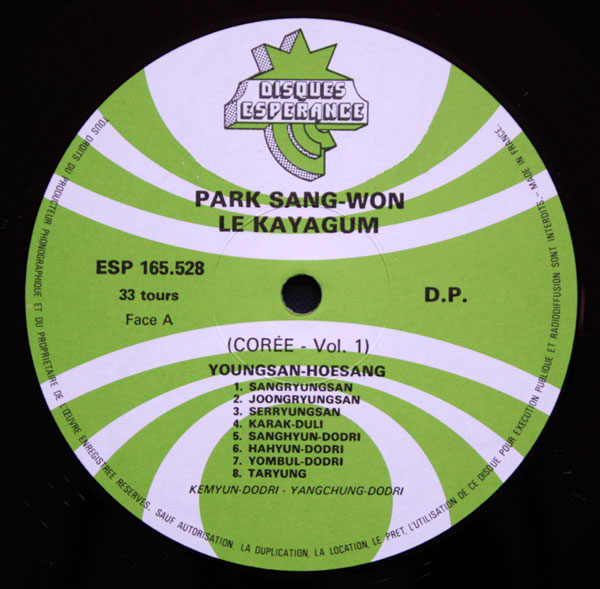
ESP 165.528 Park Sang-Won · Le Kayagum de … - P.1979


Prestige de la musique extraeuropéenne. La Corée vol.1
ESP165528 Park Sang-Won · Le Kayagum - P.1979


Face A

Yongsan-Hoesang

1 Sangryungsan
2 Joongryungsan
3 Serryungsan
4 Karak-duli
5 Sanghyun-dodri
6 Hahyun-dodri
7 Yombul-dodri
8 Taryung

Kemyun-Dodri - Yangchung-Dodri

Face B


Sanjo

1 Jinyangjo
2 Joong-Mori
3 Joongjoong-Mori
4 Kut Kuri
5 Jajin-Mori
6 Hwi-Mori


Here is an LP that came to me as a revelation in the late seventies. I was very impressed with the keeping of time in the music, especially of the Sanjo compositions. I was listening at the same time to a small ensemble playing shaman music that I had found on a set of 8 K7's that had been presented by an Korean National institute to an institution here and that I had managed to borrow. I will try later to post all of those K7's as well as they contain great music but there is still musch editing to do before they will show up here. Anyhow I start with this one out of Korea as I have not been able to find any volume 2. At least for the moment that makes the publications of this subsection complete!

Park Sang-Won

[Born in Seoul in 1950, studied traditional classical music at the National Institute for Korean Classical Music. In 1978 he was invited to the USA and in 1979 he performed at a concert of Corean Classical Music in Carnegie Hall.]


I will present more records from this series by Disques Espérance, as it has a few real pearls in it, and I will publish my attempts at a discography of the series pompously named "Prestige de la musique extraeuropéenne" in as much detail as possible, at least as far as I have been able to reconstruct it by today. Any more information is most welcome. See my previous post for a first list of titles!

Tuesday, November 2, 2010

Prestige de la Musique Extraeuropéenne - Disques Espérance

The French label Disques Epérance had a very ambitious catalogue in the seventies of Asian music mostly in the classical traditions and with a heavily lopsided slanting towards the Indian traditions. Most of their catalogue consisted of publications on Indian classical music, but also included some titles as we shall later see, from Japan, Korea, China, Nepal, and Tibet.

The series started out with a very pompous name that seams to have changed at least once during the years of publication. I will try to restore some of that catalogue and although I do not have all the titles available I feel I have enough to start with and at least take a stab at it. Hopefully the ones I am missing will surface either from some of my helpful friends or who knows, from an innocent bystander, good natured and kindhearted enough to help out.

So here I have the pleasure to present, in its various sub series, the catalogue of:


Disques Espérance
Prestige de la Musique Extraeuropéenne


Prestige de la Musique Extraeuropéenne - L'Inde

ESP 155530 Le Sitar de Nikhil Banerjee - vol.1 Râga Momonmanjeri - P.1976
ESP 155532 La Flute de Hariprasad Chaurasia (flûte) Râga Shudh Sarang - P.1976
ESP 155537 Le Sarode de Brij Narayan - P.1976
ESP 155538 Le Sarangi de Ram Narayan vol.4 - P.1976
ESP 155548 Le Violon de M.S. Gopalakrishnan vol.5 Raga Bhairavi
ESP 165504 Pandit Nikhil Banerjee (Sitar) Râga Piloo
ESP 165510 La Vina de S. Balachander vol.6 Raga Mayamalavagaula
ESP 165516 La Flute de N. Ramani (flûte) Bhajan Cheyavadha

ESP 165532 Les Sitar et Surbahar de Narendra Bataju (Nepal?)
ESP 165540 Le Sitar de Nikhil Banerjee (Sitar) Râga Desh
ESP 165543 Le Santur de O.P. Chourasiya vol.8 - P.1981

Traditions Classiques de l'Orient - L'Inde

ESP 8401 Le Chant mystique des Bauls "Revêts ton costume Baul"
ESP 8402 Pandit Nikhil Banerjee (Sitar) Raga Jogiyâ-Kalingada - vol.10
ESP 8403 Pandit Hari Prasad Chaurasia (flûte) Raga Lalit
ESP 8408 La Flute de Pandit Hari Prasad Chaurasia (flûte) Raga Bhupali
ESP 8409 Krishnamurti Sridar (Sarod) Râga Malkauns
ESP 8410 Ustad Amjad Ali Khan (Sarod) Deux râgas de l'après-midi "Râga Shuddh-Sarang"
ESP 8412 Parveen Sultana et Dilshad Khan (chant khayal) Râga Kalavati
ESP 8413 Le Chant Dhrupad de Ustad Zia Fariduddin Dagar - vol.15
ESP 8414 Pandit Nikhil Banerjee (sitar) Râga Patdeep
ESP 8416 Pandit Hari Prasad Chaurasia (flûte) Râga Madhyamad Sarang
ESP 8426 Pandit Hari Prasad Chaurasia (flûte) Râga Yaman
ESP 8439 Le Shahnai D'Ustad Bismillah Khan - Traditions Classiques de l'Orient - Inde Vol. 19

I also have found a listing of this LP but it looks as if there is a typo in the catalogue number and therefore needs further investigation. Maybe someone who has the record can help!

(ESP 8402 Le Violon de l'Inde du Sud : L. Subramaniam vol. 10 - P.1983)

Prestige de la musique extraeuropéenne - La Corée

ESP165528 Park Sang-Won - Kayagum vol. 1 - P.1979


Prestige de la Musique Extraeuropéenne - Le Japon

ESP 155551
Hiromu Handa - Le Koto de Hiromu Handa, Vol. 1
- P.1977
ESP 165505 Le Koto de Yusen Kuzuhara - Vol. 2 - P.1978
ESP 165506 Le
Koto de
Yusen Kuzuhara et le
Shakuhachi de
Teiji Itoh - Vol. 3
- P.1978

Traditions Classiques de l'Orient - Chine Vol 1

ESP 8417 Troupe Paysanne du Luochan (musique du théâtre d'ombres) Le village de Dajia


I do not know under what serial title the following LP was issued, but it is maybe also from China even though it is from Tibet ;-)

(I cannot say if it is recorded in Chinese Tibet or in India, as I have not seen the physical records.)

ESP 8433 Théâtre musical tibétain "Prince Norsang"


I have not yet established the year of publication for some of the titles and in some instances I have not been able to give the volume number. I am sure there must be some missing records as well, so any additional information is most welcome!

Hope someone finds this useful and will enjoy the LP's that are to come!