Saturday, June 12, 2010

Classical Music of India - Recordings by John Levy P.1969


Classical Music of India
Featuring renowned soloists
Recordings by John Levy
Nonesuch Explorer - H 72614 - P. 1969


Side 1

A1 Bansri (tranverse flute) Yaman 8'10 Devindra Murdeshwar
A2 Sarangi (fiddle) Puriyadhanashri 6'12 Fateh Khan
A3 Jaltarang (cup-harmonicon) Bhupali 4'35 Chintamani Jain
A4 Thumri (love-song) Bhairavi 6'11 Mohammed Ismail

Side 2

B1 Rudra Vina (stick zither) Chandrakauns 5'40 Zia Mohiuddin Dagar
B2 Haveli Sangit (devotional song) Gauri 14'25 Amarlal
B3 Naubat Shahna'i (Royal Gateway Music) Todi 7'40 Suleiman Jumma & Sumar Jumani, Abdullah Ramatulla


This LP comes with an accompanying leaflet with annotations by John Levy and Jairazbhoy.


Graciously recieved by his Excellency, who was in very good spirits, I partook in an unplanned and most impromptu repast at his mansion some afternoons ago. As on previous occasions music is always omnipresent, and in the continued sitting that ensued, where selfless presence were being expounded while leisurly sipping tea contemplating the there and now, we came upon the topics of many good artists that have long passed. And sighing, that even thou there are many young budding talents, the reasons for making the music seems to have fundamentally changed.


Suleiman Jumma & Sumar Jumani, Abdullah Ramatulla

His Excellency suddenly mentioned the Naubat Shahna'i piece represented on the LP in the latest blogpost, the John Levy compilation on CBS. I was bemused that he took time to follow my blog and even more so when he said he had been inspired by the idea to preserve these old records and I was very happy indeed to see him pulling out another record, saying that those recordings, also by John Levy, must have been made around the same time as the one in my post. To my big surprise there was not only tracks with Naubat Shahna'i, but one more track with jaltarang, also by Chintamani Jain, a sarangi track by Fateh Khan and above all, a short but very good Chandrakauns, played on the been by Ustad Zia Mohiuddin Dagar.


Zia Mohiuddin Dagar


Chintamani Jain

Hidayat Khan

Mohammed Ismail

He kindly lent me his copy of the record and I hope you will all enjoy. He was even kind enough to let me botanize on my own in the shelves, so I can assure you that there are several other good and rare records that will follow. It was also understood that our meetings could maybe be elevated to a jour fixe, set aside for music and contemplation.


Devindra Murdeshwar

Fateh Khan

Amarlal


Thursday, June 10, 2010

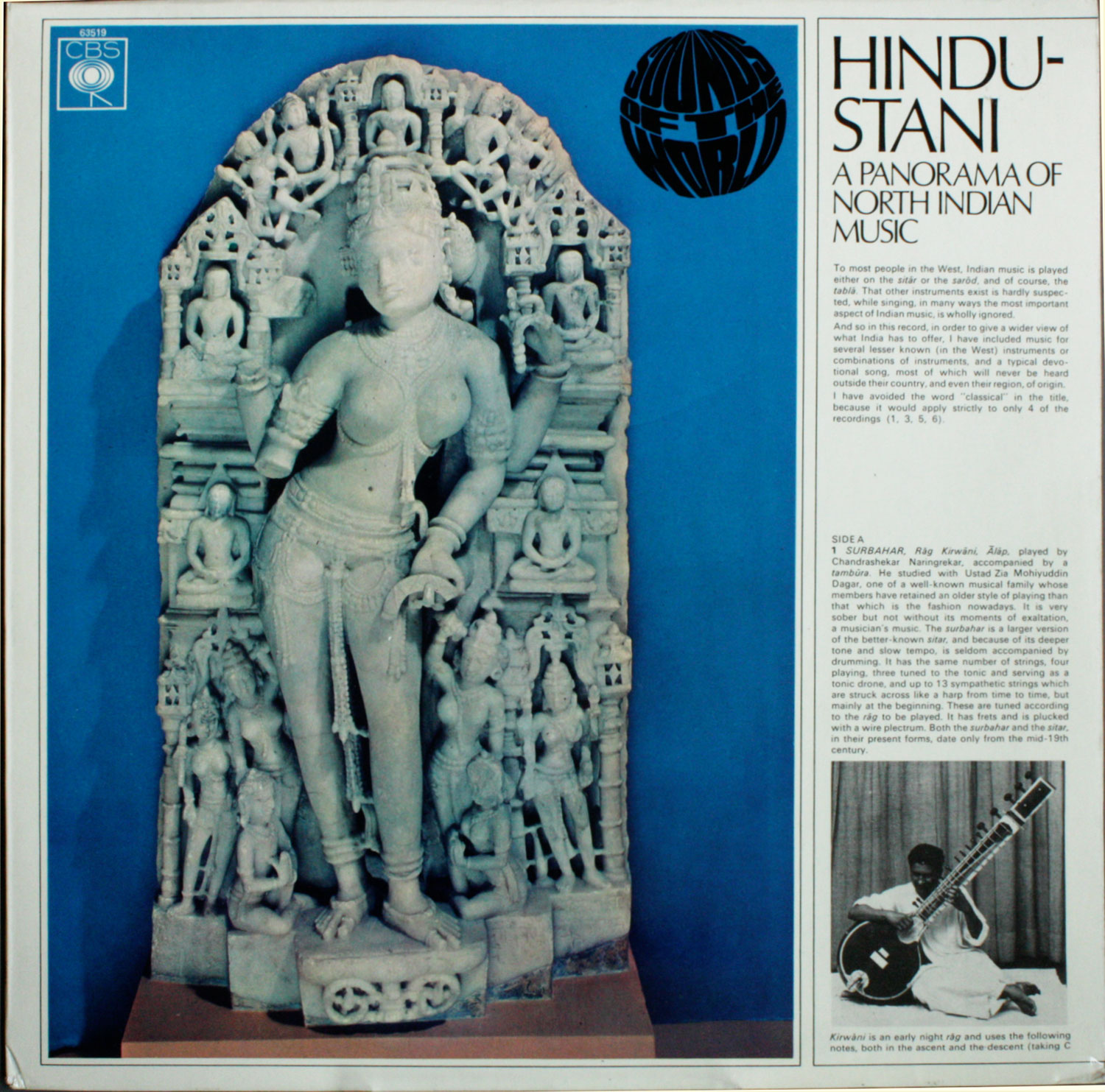
Hindustani - A Panorama of North Indian Music


Hindustani - A Panorama of North Indian Music - Sounds of the World
CBS - CBS 63519 P. 1969 (recordings by John Levy)


A1 Surbahar - Rag Kirwani - Chandrashekar Naringrekar
A2 Mirabai Bhajan - Rag Madh - Mohanlal Rayani
A3 Jaltarang - Rag Gunakri - Chintamani Jain

B1 Naubat Shanna'i - Rag Sindhu Bhairavi
B2 Tabla solo - Fayyaz Khan
B3 Sarangi - Raag Maru Bihaag - Sabri Khan


I'll share some more instrumental Hindustani Classical before I move on to the vocal.
I passed by the editorial office of Panchamkauns the other day and as they were all out for lunch, I started to skim through the dimly lit shelfs in a storageroom behind the office when I stumbled upon this absolutely forgotten wax. It was standing there with some Bade Ghulam Ali Khan, a few Balachanders, and generally items that no one seemed to have given a thought about for ages.

As I had never seen it before and as it contained a track that I had never heard by my friend Chandu, the Sitar & Surbahar player who prematurely passed away only a few years ago. I decided to quickly save that and some of the others for posterity and as it turns out, no one at the office has missed them yet. I guess they are all busy writing critiques of newly released CD's anyhow. I will return them of course, but not until I've digitized them and shared them here...


Chandrasekhar "Chandu" Naringrekar 1936 - 2004


Sabri Khan 1927 -


Naqqara & Shahnai - The Royal Gateway Music


Here is the first of the records I lifted off their shelfs ...


Nikhil Banerjee - Ragas - Lalit, Sindhu Bhairavi, Puriya Kalyan


EMI Music from India Series - ⑥
Nikhil Banerjee - Raga Lalit, Raga Sindhu Bhairavi, Raga Puriya Kalyan
HMV Great Britain - ASD 2394 - P.1968


A1 Raga Lalith
A2 Raga Sindhu Bhairavi

B1 Raga Puriya Kalyan


This LP by Nikhil Banerjee was the third LP from this series that I came in contact with and I post it here and will go on with the others as they materialize.

The whole series ran as listed in the previous post and I don't know of any higher number than vol. 11. So if you know better, I would be delighted if you please inform me. Also I feel a certain need to declare that this is in no way the best of the best Indian music as I understand it today or as my taste has evolved. But this is what really got me hooked. The change in taste was especially noticable, when I, upon moving to a larger city and finding more knowledgable new friends with similar but more developed tastes came in contact with the vocal music. I almost immediately stopped listening to any instrumental and immersed myself in the beautifully expressional voices of India first north and then south. Still most indian classical buffs where only into "instrumental" but in the vocal muisc I where to find much more satisfaction. Not that I don't appreciate instrumental, I still do, but the voice, and especially the male voice, is more attuned to my ear. Later posts will cover much of that and then, when still a little later I also discovered the magic intensity and glow of the Karnatic Music with The Saint composers of the Trinity and Swathi Thirunal the sky opened much wider and my heaven became bigger...

But now I am running ahead of myself, so more about that later...


Ustad Bismillah Khan & Prof. V.G. Jog - Duets


EMI Music of India Series - ③
Ustad Bismillah Khan & Prof. V.G. Jog - Duets
EMI Great Britain - ASD 2312 - P.1965


A1 Raga Jai Jaiwanti

B1 Raga Bahar; Dhun in Mishra Khamaj


Here is the second LP that managed to buy and that I talked about in my previous post.
It was also a jugalbandi of the same wonderful Bismillah Khan with the delicate violin of V.G. Jog. I continued to stay in a blissful state and although there had been some strong opposition from some family members about this record being played all hours of the day I was very happy when my mother some time after I had moved away from home asked me if I could make her a cassette copy of these two records she missed them badly and over the years I shared with her many of the later trouves of classical Indian music. She really had very good taste and open ears when given the chance to listen.


Vilayat Khan & Bismillah Khan - Duets


EMI Music of India Series - ①
Vilayat Khan and Bismillah Khan - Duets
EMI Great Britain - ALP 2295 - P.1967


A1 Duetto - Jugalbandi - Raga Gujaree - Todi

B1 Chaiti - Dhun
B2 Bhairavee - Thumree


In the late fifties and early sixties there were very few possibilities for an adventurous kid like myself to hear any non "western" music. (please excuse the expression it is really as daft as the expression "World"-music, but I hope you interpret it as according to my intention) I remember trying hard on the shortwave to find any such music and remember at least now and then finding some arabic music probably from French stations catering to the north African diaspora.

Mostly, if there were any hints at all at such music it was just to add some exotic flavour in movies and almost never autenthic at that. This was especially true in the northern countries of Europe and even more so if you like me were born and grew up in a small rural community with no dedicated record dealers but where the whole stock of records were sold in the basement of the bookshop where they would not let you in unless it was clear that you really appreciated Western Classical music and would behave. Even Bill Haleys "Rock around the clock" was frowned upon and when my father ordered a copy of that on 78 rpm from them i was already stigmatized. The only other source for records were by the same shop that made a better living selling Milk, Bread and Butter. But there, to my utter disbelief, one day when scrutinizing their sale of left behind LP's with music that none of the locals would wrap their ears around, there in the daily supplies shop, right next to the shelf's of children toys, I was pulling up two Indian classical LP's in the EMI Music of India Series vol. 1 and 3. They were at half prize, a ridicilous sum today but still astronomic for a teenager like myself back then. I could not afford them but I insisted that the shop assistant, even thou he said that no one would buy them anyhow, put them aside in my name, and I made a promize to come up with the sum whitin two days. Those were sleepless nights and my mother who always supported me especially in quest for music still reluctantly and not really seeing what an opportunity this was, finally caved in and gave me the money to buy one of them. Terrible dilemma to choose and I had not heard a single note from either albums. I went with the most "autenthic" looking picture, I think it was the instruments and the concert mat that got me. And I bought vol. 1 but still insisting that they keep the other volume a few more days.


The clerk agreed, but could not believe that I wanted both, as they had been delivered to the store by mistake and that they had actually ordered other records but gotten these as the catalogue numbers had been similar or something like that. He even agreed to knock of a little more on the prize and I went home to listen to the first LP. The feeling was none other than total bliss. Finally I had heard real music that was not just trying to entertain you but regarded the listener as also having a soul and maybe in need of healing. The music was like a flight, a long journey at times floating down the river, a wonderful vehicle for the extreme longing I was specializing in, but at the same time a reliever of pain. I was completely overwhelmed and after repeated listenings also entering a satiated stage like I had finally gotten nourishment for my mind and not only heart and they they were one, and a feeling of coming home at last.

Nowhere was this occidental feeling of a rift between the body and soul, between the heart and mind. And finally, after listening over and over again I was in a constant state of total bliss.
A few days went by and I don't really remember how, but I think I found and sold scrap metal to a scrap dealer and came up with most of the money myself, probably my mother helped out a little again and I got the second record! This time at half the half prize!


So here is the first LP of Indian music that I heard and I am ever so thankful for that wrong delivery, as my life since then, has never been without a serious amount of Indian Music. These were not the orthodox classical repertoire as it had become a fad with "Duets" i.e Jugalbandi, actually still a very vital genre, but not always with as good results as these two samples. The quality is preserved here in spite of the at the time nouveauté, mainly because of the stature of the performing musicians. I remember the first listen to shenai to be overworldly and I have a special soft spot for Bismillah Khan ever since. I had only heard something similar litstening to the soprano of John Coltrane. Something that also happened around the same time as this.


Wednesday, June 9, 2010

EMI Music from India Series vol. 1-11


EMI Music from India Series vol. 1-11

Vilayat Khan & Bismillah Khan • P.1967 HMV
ASD 2295 • Duets (Jugalbandi): Chaiti-Dhun; Bhairavi-Thumree

Music from India Series - ②
Ravi Shankar & Ali Akbar Khan • P.1965 HMV
ASD 2304 • Duets: Raga Shree; Raga Sindhu Bhairavi

Ustad Bismillah Khan & Prof. V. G. Jog • P. 1965 HMV
ASD 2312 • Duets: Raga Jai Jaiwanti; Raga Bahar; Dhun in Mishra Khamaj

Music from India Series - ④
Ravi Shankar 1967 • HMV
ASD 2341 • Raga Khamaj, Raga Lalit

Music from India Series - ⑤
Ali Akbar Khan • HMV
ASD 2367 • Raga Durga; Dhun in Khamaj

Nikhil Banerjee • P.1968 HMV
ASD 2394 • Raga Lalit, Raga Sindhu Bhairavi, Raga Puriya Kalyan

Music from India Series - ⑦
Vilayat Khan • HMV
ASD 2425 • Raga Yaman

Music from India Series - ⑧
Ravi Shankar • HMV
ASD 2418 • Raga Nata Bhairav; Raga Mishra Piloo

Music from India Series - ⑨
Bismillah Khan • P.1969 HMV
ASD 2446 • Raga Sarang; Raga Dadra; Raga Chandra Kauns; Raga Kajaree

Music from India Series - ⑩
Imrat Khan & Manik Rao Popatkar • HMV
ASD 2461 • Raga Marva, Raga Suddha Saranga

Music from India Series - ⑪
Ustad Vilayat Khan • P.1969 EMI
ASD 2460 • Ragas Jaijaiwanti, Rageshree


In some coming posts I will try to reconstruct most (well, hopefully all) of the above catalogue but I will first post the three LP's that I came in contact with when I first started to listen too Indian classical music, and then later I will go on with the others as they materialize.


Music in the following posts...

Sunday, June 6, 2010

Ren Qingzhi - Han River Rhymes - 任清志 -漢江韻


Ren Qingzhi - Han River Rhymes
Art Tune Company Hong Kong - COL 3137 - P. 1970's


任清志演奏 - 漢江韻
香港藝聲唱片公司 - COL 3137 - P. 1970's


第 1 面

1. 潯陽夜月 - (高胡,古箏二重奏)
2. 漁歌 - (高胡,古箏二重奏)


第 2 面

1. 幸福渠 - (高胡,古箏獨奏)
2. 漢江韻 - (高胡,古箏獨奏)
3. 落院 - (高胡,古箏獨奏)
4. 河南曲牌聯奏 - (高胡,古箏獨奏)


Side A

A1 Xunyang moon night (Gaohu and Guzheng duo)
A2 Fisherman's Song (Gaohu and Guzheng duo)

Side B

B1 Channels of Fortune (Gaohu and Guzheng duo)
B2 Han River Rhymes (Gaohu and Guzheng duo)
B3 Down Home (Gaohu and Guzheng duo)
B4 Henan Tunes, medley (Gaohu and Guzheng duo)


Qing Renzhi, born 1924, in the Deng County of Henan province. He is concidered one of the main representatives of the Henan School.

Tablature notation for the piece Han River Rhymes - 漢江韻


Liu Tianhua - Erhu Solos - 1929-1932


Liu Tianhua - Erhu Solos (composer)
Art Tune Company Hong Kong - COL 3011 - P. 1970's
(most recordings played by various artists most likely between 1960's-1970's)


劉天華二胡演奏 - 二胡獨奏
香港藝聲唱片公司 - COL 3137 - P. 1970's


第 1 面

1. 空山鳥語 - 張韶
2. 彈樂 - 孫文明
3. 燭影搖紅 - 張銳
4. 悲歌 - 張銳
5. 月夜 - 張銳
6. 良宵 - 張銳


第 2 面

7. 病中含 - 蔣風之
8. 苦中樂 - 蔣風之
9. 閒居含 - 蔣風之
10. 獨弦操 - 甘柏林


The titles of songs are often hard to render into english, and as all the tunes here are standards, there may be other, more common translations. These are all my stab at giving some english titles to the songs, but if someone, more familiar with the Erhu repertoire has better suggestions, please don't hesitate to tell me so. Not that I don't listen to chinese instrumental music, but I am more familiar with the Qin, and the various opera repertoires. I will post some of that later as I find time.


Side A

A1 Birdsong in the empty mountains (1931) - Zhang Shao
A2 Plucked music - Sun Wenming
A3 Amorous shadows in candlelight - Zhang Rui
A4 Elegy - Zhang Rui
A5 Moonlight - Zhang Rui
A6 Peaceful evening - Zhang Rui

Side B

B1 Lamenting illness - Jiang Fengzhi
B2 Music in the bitterness - Jiang Fengzhi
B3 Residence leisure lament - Jiang Fengzhi
B4 Single string exercise - Gan Bolin

Liu Tianhua composed ten erhu solos, the LP has but nine of them but is missing
guāng míng xíng 光明行 (March towards brightness). Comment by Huqinblogger


Liu Tianhua (1895-1932)

Liu Tianhua (1895-1932) who is known as the "father of the Chinese Erhu" one of the most well known composers of the early generation, performer and music educator. He contributed greatly to reform and modernize traditional Chinese music and folk music. The pieces on this LP are all standards and are often the repertoire played for grading and competitions of students and young musicians. Even thou he was only 37 when he died of scarlet fever 1932 June 8 he has greatly influenced the chinese attitude towards folk music and elevated both the music and the position of the instrument. He improved both the pipa and the erhu before his solopieces more associated with beggars and he was the first to introduce erhu as a solo instrument in higher musical education.


Saturday, June 5, 2010

Hong Kong - Musical Atlas vol. 9 - Unesco Collection


Hong Kong - Musical Atlas - Unesco Collections
EMI Italiana - C 064-17968 - P. 1974


Side A

A1 Liu Pui-Yuen, p'i-p'a, Pa Wang Shih Chia - The Warrior Takes off His Armour
A2 Tsung Seung, yang-ch'in. Shu Mu Mu Yang, Shu-Muu as Shepherd
A3 Tsung Seung, yang-ch'in, Wong Kuen, hsiao. Duet: Chiang Ho Shui, Widow Mourning beside the Murmuring River
A4 Wong Kuen, ti. Ko Tzu Fei, Pigeons Flying

Side B

B1 Tong Kin-Woon, ch'in. I Ku Jên, Thinking of an Old Friend
B2 Hsiao Ming, shêng. Pu Pu Chiao, Graceful Steps of a Lovely Lady
B3 Tsui Wah-Nam, êrh-hu. Huan Lo Ts'ao Yuan, Happiness upon the Grassy Plain
B4 So Chun-Po, chêng. Kao Shan Liu Shui, High Mountain and Running Water
B5 Lui Pui-Yuen, p'i-p'a. Kao Shan Liu Shui, High Mountain and Running Water


Dolls from shadow play, piyingxi 皮影戲

Lotus painting on fan


Despite the adornments from Piyingxi 皮影戲 (shadowplay)
(the above pictures turned upside down on the cover)
there is unfortunately no music from this once so popular entertainment form.

Wong Kuen, ti, dizi 笛子

Usually my ears are very sensitive to flute and I often find it painful to listen but then again some of the best pieces I know are played on the flute. Pieces played on the Xiao, Nay, Bansuri & Shakuhachi in the lover register and slowly, usually give much satisfaction and pleasure. The piece on this record and is not my favourite but as it depicts the pigeons flying with whistles attached to their hind feathers it does give me an excellent opportunity to show you some nice pictures of the doves and the paraphernalia used. It makes a wonderful sound when they fly over in huge flocks and fading away as they fly further away from you and growing in volume as they come back overflying the roof of your house. Unfortunately this is almost impossible to enjoy any more after most of the hutongs 衚衕 (narrow alleys in Beijing) has been torn down. Nowadays the wonderful magical sound is almost completely drenched by the thick traffic and was almost dependent upon the silence of a 9 million inhabitant city that all were either on foot walking, or on bicycle. One could hear dogs barking and roosters crowing in the middle of the city and the biggest noise there was, were the bicycle bells at rush hour. You could hear the occasional lorry minutes before it showed up.


ill. How to attach thin reed whistles to the tail of pigeons.


Pigeon whistles made of reed, bamboo, and calabash

Female pigeon in full concert attire

Some of music on this record is rather nice but it was made at a time when it was really hard to get good recordings from China. I will remedy this in later posts as I have started to prepare some of my old Chinese LP's and other media recordings. It is not the first post I had intended to present good music from China, (which is increasingly hard to find for other reasons that I will dwell upon later), but it will have to suffice for now, and because it fills a place in the catalogue of the EMI Italiana Unesco Collection. It is still a mainstream traditional pleasant listen.


Bahrain - Musical Atlas v. 23 - Unesco Collection


Unesco Collection - Musical Atlas
Bahrain - Traditional Folk and Ceremonial Music
EMI Italiana - 3C 064-18371 - P. 1979


Side A

A1 Harvest Song
A2 Saut
A3 Armuti'
A4 Nayel Kurdi
A5 Haflah

Side B


B1 Mkholfi
B2 Saut Arabi
B3 Ishab-Tayyeh-Khayali
B4 Ardah


This is a very good record with several hard to find musical traditions represented. Among the music there are some good tracks of sawt my favourite tracks are b2 & b3 but in general it is an interesting recording that should be brought back to a new audience. Many thanks goes to the good hunter zwan who's generous sharing of all vinyl prey is most appreciated. In this case however the hunt is not for the kill but the exact opposite, to bring back to life! How many have seen this LP before? Raise your hands now. I was not one of them. But there are many more good ones in this series so any help to collect them are most welcome! Below are but a few listed on the back of the sleeve. I'll post a more complete list here on Anthems of Luobaniya later.